
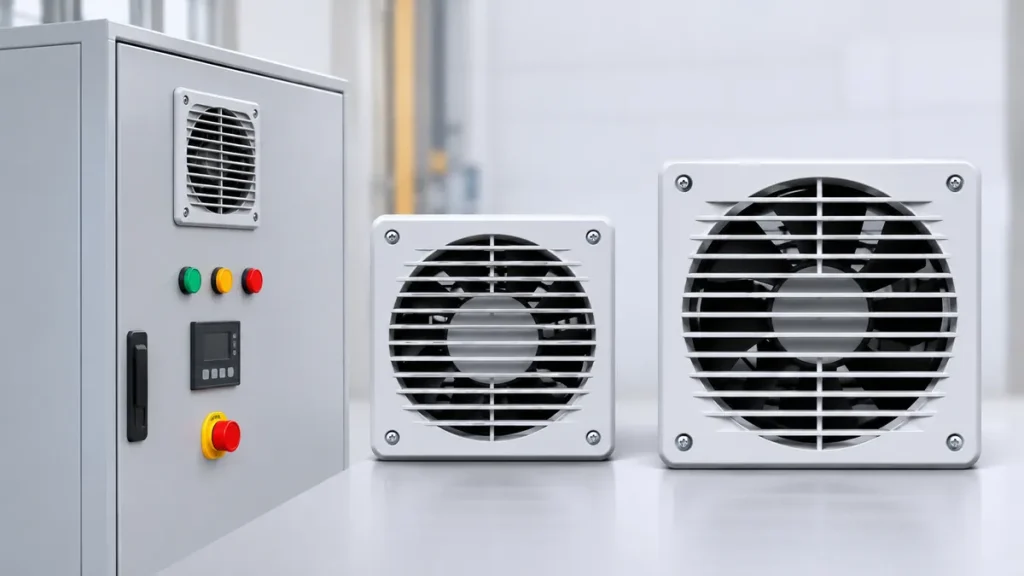
An air vent fan looks like the cheapest part in a panel. It is a small box with blades, a filter and a grille, and most buyers pick it by the size of the hole already cut in the door. Then the panel runs hot in April, the drive trips on over-temperature, and someone asks why a “ventilated” panel is cooking its own components. The fan was never sized. It was just fitted.
This guide is for people who buy and fit an air vent fan for control panels, MCC rooms, UPS rooms and similar enclosed spaces in Hyderabad. We will work out how much air you actually need, compare the 4 inch and 6 inch fan, choose a filter grade that will not choke the airflow, and see where fans stop being the right answer. If you only want the short version: size the fan on heat load and temperature rise, not on the cutout.
What an Air Vent Fan Actually Does Inside a Panel
A panel makes heat. Contactors, drives, power supplies, transformers, even busbars and lugs all lose a little energy as heat. That heat has nowhere to go inside a closed box, so the air temperature climbs until the steel walls pass enough heat to the outside. For a small, lightly loaded panel that happens at a safe temperature. For a drive panel in a Hyderabad plant room in May, it often does not.
A panel ventilation fan with a filter solves this the simple way. A fan on one side pulls cool outside air in through a filter. Hot air leaves through an exhaust grille on the other side, usually placed higher up because warm air rises. You will see this set-up sold as a fan filter unit, an exhaust fan with filter, or just an air vent fan. The ones sold on Indian counters are usually 4 inch, 6 inch or 8 inch in nominal size, in 230 V AC or 24 V DC versions.
The key limit is physical. A fan can only bring the inside of the panel close to the temperature of the air outside. It cannot cool it below that. We will come back to why this one fact decides whether you need fans at all.
Step One: Find Your Heat Load in Watts
Everything starts with the watts of heat the panel dissipates, usually written as Pv. There are three honest ways to get it.
- From the datasheets. Most contactors, MCCBs, drives, SMPS units and relays list their power loss in watts. Add them up, using the loss at your actual running current, not the nameplate maximum.
- From a rule of thumb for drives. A variable frequency drive typically gives off a few percent of its rated power as heat. Treat the figure as a starting point and confirm it from the drive manual, because it differs by make and rating.
- From a measurement. On an existing panel, a data logger inside and one outside over a hot afternoon tells you the real temperature rise. This is the most reliable method when you are fixing a panel that already overheats.
Do not forget the quiet heat sources. Power supplies, transformers and soft starters in continuous bypass carry on losing watts all day. A cabinet that “only has a few relays” can still hold a 24 V power supply running at 85 percent efficiency, and the other 15 percent of its output becomes heat in your enclosure.
Step Two: Decide the Temperature Rise You Can Afford
Now pick two temperatures. The first is the highest ambient air your panel will see. In Hyderabad, an outdoor or semi-open location in summer can be 40 to 45 degrees C. The second is the maximum internal temperature the components allow. Many control devices are rated up to about 55 degrees C inside the enclosure, and some drives derate above 40 degrees C. Read the datasheet of your most sensitive device, since that one sets the limit.
The difference between these two is your allowed temperature rise, called delta T. If the ambient is 40 degrees C and you allow 50 degrees C inside, delta T is 10 K. If the ambient is 45 and the limit is 50, you have only 5 K to work with.
Step Three: The Airflow Formula
The standard enclosure-cooling relationship is simple enough to use on paper:
Airflow (m3/h) = 3.1 x Pv (watts) / delta T (K)
The constant 3.1 comes from the heat capacity of air at normal conditions. Hyderabad sits at roughly 540 metres above sea level, where air is slightly thinner, so a small allowance is sensible. To convert to CFM, the unit most fan labels in India still use, multiply cubic metres per hour by 0.589.
Here is a worked example with plain numbers.
- Panel heat load: 800 W (a drive panel with a few contactors and a power supply)
- Ambient: 40 degrees C, allowed internal: 50 degrees C, so delta T = 10 K
- Airflow needed: 3.1 x 800 / 10 = 248 m3/h, which is about 146 CFM
That 146 CFM is the air the fan must actually move once installed, not what is printed on its box. Which brings us to the number people forget.
Why a Fan’s Rated CFM Is Never the Delivered CFM
The CFM on a fan label is its free-air figure, measured with nothing in the way. Fit a filter and an exhaust grille and the fan works against resistance, so it delivers less. How much less depends on the filter and the fan curve. A clean coarse filter might cost you a modest slice of the airflow, a finer or dirty one costs far more. Panels in dusty Hyderabad industrial areas such as Jeedimetla, Balanagar or the Pashamylaram belt clog their filters faster than you would think.
Practical rule: buy a fan whose rated flow is at least 1.5 times the calculated figure, and ask the maker for the airflow with the filter fitted if they publish it. In the example above, a fan or pair of fans rated at roughly 220 CFM would be a sensible target for the 146 CFM requirement.
4 Inch vs 6 Inch Fan: How to Choose
The nominal size mostly tells you the cutout and the airflow range. It does not tell you the correct choice. Use this thinking instead.
The 4 inch fan suits small control panels, DB-style boxes, PLC cabinets and meter boxes with a modest heat load, in the range of tens to a couple of hundred watts. It is compact, cheap and easy to fit in a door. Where heat is a little higher, two 4 inch units, one for intake and one for exhaust, often beat one bigger fan because the airflow is spread across the panel.
The 6 inch fan is the usual pick for drive panels, UPS cabinets and MCC sections where the load runs into several hundred watts. It moves noticeably more air at lower speed, which also means less noise and a longer bearing life. The price is a bigger cutout and a thicker door requirement, so check the panel design before you commit.
Whichever size you choose, match these four things before buying.
- Cutout and mounting. Fan filter units are not standard across makes. Measure the existing cutout and check the datasheet figure rather than the inch number.
- Voltage. A 230 V AC fan is simplest. A 24 V DC fan can run off the panel’s own supply and is easier to control, but make sure the supply has the spare current.
- Bearing type. Ball bearing fans cost more than sleeve bearing fans but last much longer in a warm panel. For a panel that runs all day, this is where the money is well spent.
- Rated life and noise. Look for the stated life figure in hours and the decibel rating if the panel sits in an office or control room.
Filter Grade: Where Most Ventilation Goes Wrong
The filter is the part that fails first, and its grade decides how often. Filter classes are written as G2, G3 or G4 for coarse dust, based on the older European standard that suppliers still quote. A higher number catches finer dust but pushes back harder on the air. For most Indian installations a G3 or G4 coarse filter is the sensible balance.
Be realistic about what a filter does. It keeps out insects, leaves and coarse dust. It does not make the panel airtight, and it does not stop humid air or fine conductive dust. If the air outside carries oil mist, metal dust or corrosive fumes, a filtered fan is the wrong tool. Use a sealed enclosure with a heat exchanger or an air conditioner instead.
Plan for maintenance. A clogged filter quietly turns your carefully sized fan into a half-sized one. In dusty plants, write a monthly check into the maintenance schedule. In cleaner commercial buildings, quarterly is usually fine. Replace the filter mat rather than washing it more than once or twice, since washing loosens the fibres.
Where the Panel IP Rating Goes
A panel with open ventilation cannot keep its original sealed rating. IP ratings are defined in IEC 60529, and a fan-filter set-up typically brings a panel down to around IP54 when fitted correctly with a proper grille and gasket. That is fine inside a clean room. It is not fine for a wash-down area or outdoors with rain exposure unless the exhaust has a rain hood. Check the rating of the fan unit itself, and do not assume the panel keeps IP65 just because the door still closes.
Design the airflow path too. Put the intake low on one side and the exhaust high on the other, so air sweeps across the hot parts. Do not place the fan right next to a drive’s own heat sink exhaust or it will recirculate the same hot air. Keep cable trays and loose wire bundles out of the airflow path.
When Fans Are the Wrong Answer
This is the part sales brochures skip. A fan cools the panel to a few degrees above the ambient air. So the fans only work if there is a gap between the outside temperature and the limit inside.
If the allowed delta T works out under about 10 K, the airflow needed becomes huge and fans stop making sense. In that case you need something that cools below ambient or removes heat without using outside air. The options are:
- A heat exchanger. Good for dusty places, since it keeps the inside air separate from the outside air. It still depends on ambient being lower than the limit.
- A panel air conditioner or cooling unit. The right answer for high heat loads, high ambient, or sealed IP55 and IP65 enclosures. It uses real refrigeration and can hold the inside below ambient.
- Moving the heat source. Sometimes the cleanest fix is placing the drive outside the panel on a heat-sink mount, or upgrading to a lower-loss device.
As a quick filter: if your calculated airflow is small and ambient is comfortably below the component limit, use fans. If the maths gives a very large airflow, or the plant air is dirty, go to a cooling unit.
Beyond Panels: An Air Vent Fan for Rooms
The same keyword gets searched by people who want a ventilation fan for a room, toilet, kitchen or small plant room. The method is similar. Work out the room volume, pick the air changes per hour, and divide. Air changes per hour is how many times the full room volume of air is replaced every hour. The National Building Code of India has ranges for different spaces, and kitchens and toilets sit at the high end while ordinary rooms sit lower. Use the figure for your building type rather than guessing.
For electrical rooms there is one extra point. A battery room or a UPS room with lead-acid batteries needs proper ventilation to disperse gases from charging. Do not put a plain domestic exhaust fan on a battery room and call it done. Use a fan suited to the area and get the design checked against the battery maker’s guidance. For a DG set room, the radiator and combustion air requirement is set by the engine, so follow the DG maker’s data sheet instead of a general rule.
Common Mistakes We See
- Sizing from the cutout. Whatever hole already exists gets whatever fan fits it. The heat load never gets calculated.
- Ignoring the filter. A fan rated for 100 CFM free air will not give 100 CFM with a filter on, and a dirty filter makes it worse.
- Intake and exhaust on the same side. The fan then recirculates the same warm air.
- Expecting a fan to beat ambient. It cannot. At 45 degrees C outside with a 50 degrees C limit, there is no fan big enough to do the job comfortably.
- Forgetting a thermostat. A fan that runs all day wears out and sucks in dust it does not need to. A simple adjustable thermostat set to switch on at about 35 to 40 degrees C saves bearings and filters. The temperature controllers stocked in our panel accessories range are an easy way to add this.
- Mixing a wet or dusty site with a filtered fan. Match the cooling method to the environment, not to the budget.
Buying an Air Vent Fan in Hyderabad
When you buy locally, a few habits save trouble. Take the panel’s heat-load figure or at least the list of devices inside it, the cutout dimensions, the supply voltage and the ambient conditions. A good counter will ask you for these. If nobody does, be careful.
At eNarayan Elex in Rasoolpura we stock panel cooling and enclosure accessories alongside the rest of the panel range, so you can match the fan to the enclosure, cable entry and thermal parts in one visit. Our Hicool panel cooling fans page lists the compact AC fans we carry, and the wider panel accessories category covers enclosures, timers, temperature controllers and wiring accessories. If your project is a full panel build, our control panel accessories buyer’s checklist walks through the rest of the parts list so nothing gets missed.
For room and building ventilation, see the lighting and fans category and the Crompton fans range, and ask our team about exhaust fans in the size you need. Stock changes, so confirm availability and the exact model before you plan the work.
Frequently Asked Questions
What size air vent fan do I need for my control panel?
It depends on the heat inside and the temperature rise you can allow, not on the door cutout. Use airflow in cubic metres per hour = 3.1 x heat load in watts / allowed temperature rise in kelvin. Multiply the result by about 1.5 to cover filter resistance, then pick a fan or fans that deliver at least that.
Is a 4 inch or 6 inch fan better for a panel?
Neither is better in general. A 4 inch fan suits small control panels with a light heat load. A 6 inch fan suits drive, UPS and MCC panels with several hundred watts of heat. For mid-size loads, two 4 inch fans spread the airflow better than one big one.
Which filter grade should I use on a panel fan?
For most Indian installations, a G3 or G4 coarse filter is a good balance between catching dust and letting air through. Finer filters clog faster and cut airflow. If the air has oil mist, metal dust or fumes, use a sealed enclosure with a heat exchanger or cooling unit instead.
Can a fan cool a panel below the outside temperature?
No. A fan only brings the inside air close to the outside air temperature, usually a few degrees above it. If your components need the inside to stay cooler than the ambient allows, you need a panel air conditioner or a similar cooling unit.
Does a panel fan reduce the IP rating?
Yes. An open ventilation path means the panel loses its sealed rating. A properly fitted fan and filter set typically gives around IP54, as defined in IEC 60529. Check the rating of the specific fan unit and add a rain hood for any outdoor exhaust.
How often should I clean or replace the panel fan filter?
Check monthly in dusty industrial areas and about every three months in clean commercial buildings. Replace the mat when it is clogged or has been washed once or twice, since a blocked filter can cut airflow by a lot.
Where can I buy an air vent fan in Hyderabad?
You can get panel ventilation fans and cooling accessories from eNarayan Elex, Rasoolpura, Hyderabad. Call 040-66768696 or write to sales@enarayan.com with your panel heat load and cutout size and we will help you pick a suitable unit.
Not sure what your panel dissipates? Send us the device list and ambient conditions, and our team will help you size the fan and filter before you order. Visit eNarayan Elex at Rasoolpura, call 040-66768696 or email sales@enarayan.com.
