
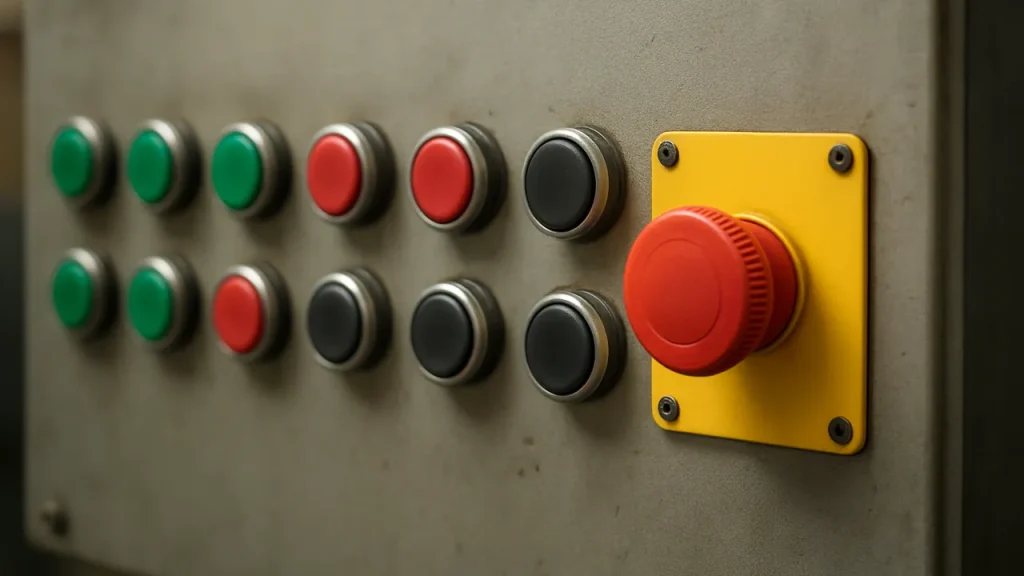
A push button looks like the simplest part in a control panel. It is a small plastic head on a metal base, and it costs far less than the contactor it controls. That is exactly why it gets chosen last, by whoever is standing at the counter, and why so many panels come back with the wrong colour, the wrong contact or a cutout that does not fit. If you are buying a push button for a motor starter, a pump panel or a machine control box in Hyderabad, this guide walks through what to decide, in the order you should decide it.
The short version: choose by contact block (normally open or normally closed), by head style (flush, extended or mushroom), by the cutout size on your panel door, by colour according to what the button does, and by the ingress protection (IP) rating of the place it will live. Brand comes last. Most reputable push buttons share the same 22 mm footprint and the same contact block logic, so the real mistakes are in the first five choices.
What a push button actually is
A push button is a manually operated control switch. You press it, a set of contacts changes state, and a control circuit reacts. It does not carry the motor current. A start button in a direct-on-line starter only closes a low-current circuit that energises the contactor coil. The contactor then does the heavy switching. That split matters because it tells you what a push button needs to be good at: clean contact at low current, a long mechanical life, and a body that survives dust, oil and daily use.
Push buttons are built in two parts that you buy together or separately. The operator is the head you press. The contact block sits behind it, clips onto the back, and holds the actual switching contacts. Many industrial ranges sell the head and the block as separate parts so you can mix, for example, a green flush head with one normally open and one normally closed block. The panel-mounted version is almost always the 22 mm (22.5 mm hole) family. You will also see 16 mm and 30.5 mm ranges, but unless you are replacing an existing part, 22 mm is the safe default.
Normally open vs normally closed: the first decision
Every contact block is either normally open (NO) or normally closed (NC), and this describes the resting state, with nobody touching the button.
- NO contact: open when released, closes when pressed. This is your start button, jog button and any “make something happen” function.
- NC contact: closed when released, opens when pressed. This is your stop button and any “break the circuit” function.
The stop button is wired normally closed for a safety reason. If a wire comes loose, a terminal burns or the cable is cut, the circuit opens and the machine stops. A stop button wired as normally open would simply do nothing in the same fault, and the operator would press it with no effect. This is the single most important rule in push button wiring, and it is why a start-stop station almost always has one NO block and one NC block.
Contact blocks are marked with terminal numbers. By convention, the numbers ending in 1 and 2 (for example 11-12) denote a normally closed contact, and numbers ending in 3 and 4 (for example 13-14) denote a normally open contact. Learn this and you can read any contact block in the dark. If a block you are buying has no markings, ask the counter to show you the datasheet before you take it.
A few more combinations are worth knowing about:
- 1NO + 1NC: the standard for a self-holding start button that also gives a signal to a PLC or relay.
- 2NO or 2NC: used where two separate circuits must be operated together, for example a start that both energises a contactor and lights a lamp.
- Late-break or early-make blocks: specialist items. You only need these if a control drawing asks for them.
Head styles: flush, extended and mushroom
The shape of the head decides how easy, or how hard, it is to press by accident.
Flush head. The button sits level with the bezel. It is hard to press by accident, so it suits start functions where an accidental press is a problem. In a dirty workshop, a flush head also collects less dust around the edge.
Extended (projecting) head. The button stands proud of the bezel. It is easy to find with a gloved hand and is the usual choice for stop buttons. There is a trade-off. Because it projects, a careless elbow or a falling tool can operate it. Pair an extended stop button with a start button in a recessed or flush style and you build in a small, free safety margin.
Mushroom head. A large, domed head, usually 30 mm or 40 mm across, that you can slap with the whole palm. Used for emergency stops and heavy-duty stops. A mushroom head with push-to-lock, twist-to-release action is the type you see on machines. A spring-return mushroom is also made, and it is fine for a normal stop, but it is not an emergency stop button and should not be sold or installed as one.
There are also illuminated push buttons, where an LED or lamp sits behind a translucent lens. These are useful as combined buttons and indicators (a green start button that lights when the motor runs), and they save one cutout on a crowded door. Check the lamp voltage (24 V DC, 24 V AC or 230 V AC) before you buy. A 24 V lamp on a 230 V circuit lasts about as long as a match.
The colour code: red, green and what the rest mean
Colour is not decoration. It tells an operator what a button does before they read the label, and it matters most in the moment something goes wrong. The reference standards are IEC 60204-1 (electrical equipment of machines) and IEC 60073 (coding principles for indicators and actuators). In India, the equivalent IS/IEC series applies, and most machine builders simply follow the IEC tables.
| Colour | Typical meaning | Where you will use it |
|---|---|---|
| Red | Emergency stop, stop or off | Stop buttons, E-stop on a yellow backing plate |
| Green | Start or on | Start buttons |
| Yellow | Abnormal condition, intervention | Reset after a fault, override |
| Blue | Mandatory action, reset | Resetting a protection device |
| White, grey or black | No specific meaning | General functions, jog, auxiliary, up/down |
Two details catch people out. First, for emergency stop you want a red mushroom head on a yellow background (the yellow plate or ring). A red mushroom on a grey plate is not what the standard asks for. Second, the standard actually prefers black, grey or white for start and stop on some machines, with green and red allowed. Do not argue this with a customer who wants red and green on a simple pump panel. Red for stop and green for start is universally understood and fine for ordinary motor control. If you are building a machine for export, or for a client who has a specification, read it and follow it.
One more habit worth keeping: never use red for a start function, and never use green for a stop. Even if the panel is tiny and the buttons are the only ones available in stock, swap them or order the right colour. Someone will push the wrong one at the wrong moment.
Emergency stop buttons are a different product
An emergency stop is not a stop button with a bigger head. The relevant standard is IEC 60947-5-5, and a proper E-stop has three features. It latches in the pressed position, so the machine cannot restart until someone physically resets it. It has direct-opening (positive break) contacts, meaning that the contacts are forced open by the button action even if they have welded together. And it is red, mushroom-shaped, and mounted on a yellow background.
A proper E-stop usually releases by twisting or pulling, and the contacts it carries are normally closed. Buy it as an emergency stop, from a range that states compliance, and wire it as part of the safety circuit your drawing specifies. Do not substitute a standard red mushroom stop. If you are not sure whether your machine needs an E-stop, the answer is almost always yes.
Cutout size, mounting and what actually fits
Before you pick a head or a colour, measure the door. The common 22 mm family needs a round hole of 22.3 mm (often written 22.5 mm). A hole drilled even half a millimetre undersize will not take the button, and one drilled too large lets the button rotate and loosen. Panel builders usually punch the hole with a chassis punch for a clean edge.
A few practical mounting points:
- Door thickness: most 22 mm buttons clamp doors between about 1 mm and 6 mm thick. A thick door needs a longer mounting ring or a special version.
- Anti-rotation key: look for the small notch. A button without a key spins when you tighten the nut, and your legend plate ends up upside down.
- Depth behind the door: contact blocks stack backwards. A button with two or three blocks and a lamp holder needs real depth, so check the clearance to the back plate. This is a common reason a nicely fitted button fouls a DIN rail or a duct.
- Spacing: keep at least 30 mm centre-to-centre between 22 mm devices so a gloved finger does not hit two at once. Mushroom heads need more.
If you are still choosing the enclosure and the other items that go on the door and inside it, our control panel accessories buyer’s checklist covers enclosures, terminal blocks, glands, DIN rail and indicators in one place, with the relevant IS/IEC references.
IP rating: where the button will live
The IP rating tells you how well the front of the button keeps dust and water out. Hyderabad’s workshops, godowns and factories are dusty for most of the year and wet during the monsoon, so this is not a technicality.
- IP54: acceptable for a clean indoor panel, inside a control room.
- IP65: the sensible minimum for a factory floor. Dust tight, protected against water jets, and this is the most common rating on industrial 22 mm ranges.
- IP66 or IP67: for washdown areas, outdoor boxes, pump houses and anywhere a hose or heavy rain will reach it. Often needs a rubber boot over the head.
The rating only holds if the button is mounted properly. A rating of IP65 on the datasheet means nothing if the hole is oversize, the gasket is missing or the door itself is IP41. The enclosure and the button must match. If the panel is outdoors, look at the enclosure options and the panel accessories range together, rather than buying the button first and finding out later that the box lets the rain in around it.
Contact rating and life: read the datasheet line, not the brochure
On the datasheet, look for the rated operational current and utilisation category. For control circuits the common category is AC-15 (for the electromagnetic loads on AC, like contactor coils) and DC-13 (for the same on DC). A typical contact block is rated about 6 A at 240 V AC-15 or around 3 A at 240 V for the control duty. You do not need more for a contactor coil, but you need to check that the coil’s inrush fits inside the rating if the button directly switches a larger coil.
The other number is mechanical life, usually quoted in millions of operations. Industrial buttons are commonly rated at one million operations or higher. A button on a machine pressed hundreds of times a day deserves the longer rating. A button that is pressed twice a week on a water pump panel does not.
One note for PLC and electronics circuits. When the button is feeding a PLC input at 24 V DC and a few milliamps, plain silver contacts can build up a film over time and give flaky readings. Gold-plated or low-current contact blocks exist for this reason. If your button only talks to a controller, ask for the low-level version.
Common mistakes that cost you a second trip
- Wiring stop as normally open. It will test fine on the bench and fail unsafely in the field.
- Buying the head without the block. Many ranges sell them separately. You get home with a nice red head and nothing behind it.
- Ignoring depth behind the door. Three stacked blocks hit the back plate and the door will not close.
- Using a standard stop as an E-stop. It looks the same, but it does not latch or open positively.
- Wrong lamp voltage. A 24 V lamp on a 230 V control supply fails at once. Match the lamp to the control voltage, not to the mains.
- No legend plate. A row of identical black buttons on a door is a puzzle for the next electrician. Add labels.
- Mixing cutout families. Replacing one 22 mm button with a 16 mm part means a new hole and a patched door.
- Skipping the boot in a wet area. The rubber boot is cheap. A corroded block is not.
How to pick: a short worked example
Say you are building a start-stop station for a 5.5 kW borewell pump in a pump house outside Hyderabad. The control circuit runs at 230 V AC through a direct-on-line starter. Here is the thinking.
The stop button is a normally closed block with a red extended head. The start button is a normally open block with a green flush head, so it is hard to press by accident. You also want an indicator lamp for the “motor running” state, rated at 230 V AC, in green. The pump house is damp and dusty, so you choose IP65 minimum, and fit rubber boots over the heads to push it closer to IP66 on the face. You measure the door, find it is a 2 mm steel plate (fine for standard mounting), punch three 22.3 mm holes at 35 mm spacing, and confirm the blocks clear the back plate. If the pump is also near people who might need to stop it in a hurry, you add a red mushroom E-stop on a yellow plate, and wire it into the safety circuit.
That is about ten minutes of thinking, and it avoids most of the callbacks.
Buying push buttons in Hyderabad
For most one-off jobs, the sensible route is a local distributor who can show you the datasheet, hand over the heads and the blocks together, and match a legend plate to the job. Ask three things before you pay. Is the part from a recognised range with published datasheets? Is the rating (IP and contact) printed on the part or the packet? And can they supply the same range again next year, so the replacement matches?
If your panel work is built around a specific starter and protection scheme, it also helps to buy the buttons from the same family as the other devices, since the accessories tend to fit each other and share documentation. You can browse the switchgear and control range under ABB switchgear, and the supporting hardware under PTI panel accessories. For anything you cannot find, send a requirement on the enquiry page with the quantity, the control voltage, the head style and the colour, and a person will reply with what is available.
If you run a workshop or a small factory, it is worth keeping a small stock of the three most common spares: a green NO flush, a red NC extended, and a spare 1NO+1NC block. Failures happen on the shift you can least afford it.
Frequently asked questions
What is the difference between a push button and a push button switch?
There is no practical difference. People use both terms for the same part. “Push button switch” is the more common phrase in retail listings, while electricians simply say “push button” or “PB”.
Which contact should a stop button use?
A normally closed (NC) contact. If a wire breaks or a terminal fails, the circuit opens and the machine stops. A normally open stop button would fail silently.
What size hole does a 22 mm push button need?
About 22.3 mm, often written as 22.5 mm. Use a proper chassis punch. A hole that is too small will not take the button, and one that is too big lets it turn and loosen.
Is a red mushroom push button the same as an emergency stop?
No. A real emergency stop latches when pressed, has positive-opening contacts and meets IEC 60947-5-5. A plain red mushroom stop button does not. Buy and label an E-stop as an E-stop.
What colour should a start button be?
Green is the common choice for start. IEC 60204-1 also allows white, grey or black. Red should never be used for start. Stop is red or black, and emergency stop is red on a yellow background.
What IP rating do I need for a push button in a factory?
IP65 is a sensible minimum for a factory floor. Choose IP66 or IP67 where you hose down equipment or where rain can reach the panel. Remember the rating only holds when the button is fitted correctly in a suitable enclosure.
Can I use one push button for both start and stop?
You can with a toggle or latching action for simple loads, but a start-stop pair with a self-holding contactor is safer and standard for motors. Two separate buttons also give you a clear, fail-safe stop.
Do push buttons need a certain voltage rating?
Yes. Check the contact rating for your control voltage, commonly 24 V DC, 110 V AC or 230 V AC, and the utilisation category (AC-15 or DC-13). Illuminated buttons also need a lamp matched to the same voltage.
