
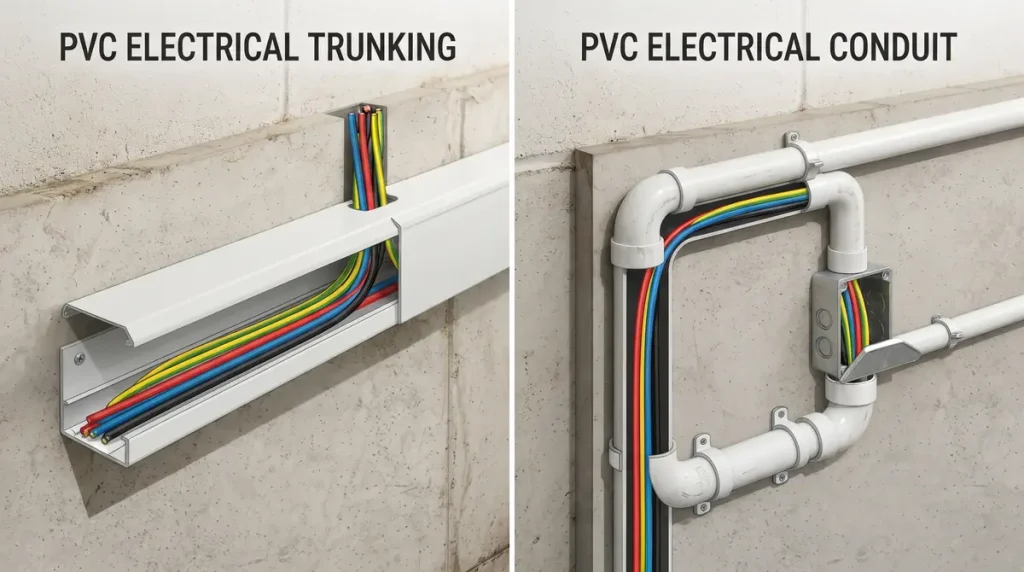
PVC trunking is the rectangular, snap-lid channel that carries a bundle of cables along a wall, a ceiling or under a counter. It is what you reach for when the cables are many, the route is exposed, and someone will need to open it again in two years to add a circuit. Conduit is what you reach for when the cable count is small and the wiring is going into plaster. Most site arguments about the two come down to one thing: nobody did the sizing sum before ordering.
This guide is for the person who has to order the material and live with the result: the electrician, the contractor, the facility manager, the office fit-out lead. We cover how trunking differs from conduit, how to size it by cable fill, how derating changes the answer, what the standards say, and what we see go wrong on Hyderabad sites.
PVC trunking vs conduit: what actually separates them
Both are plastic raceways. Both protect cable from knocks and keep it tidy. The difference is access and capacity.
Conduit is a round tube. Cables are drawn in through it, so every bend and every junction box is a place where the pull can jam. Once the cables are in, changing them means pulling everything out or running a new pipe. That is fine when the wiring is buried in a wall and will not be touched for twenty years.
Trunking is an open channel with a lid. You lay the cables in by hand, press the lid on, and you are done. To add a circuit later you lift the lid, lay the new cable alongside and close it again. No pulling, no drawing wire, no breaking the wall. That is why trunking dominates in offices, showrooms, labs, server rooms, shop fit-outs, and the inside of control panels, where changes are routine.
| Question | PVC trunking | PVC conduit |
|---|---|---|
| Where it usually goes | Surface on wall or ceiling, under desks, inside panels, above false ceilings | Concealed in plaster or slab, or surface-clipped for small runs |
| Adding a cable later | Lift lid, lay cable, close lid | Pull through, or run a fresh pipe |
| Cable count it suits | Many circuits, mixed sizes, data alongside power (with partitions) | A few circuits per pipe |
| Looks | Visible, but neat and paintable | Hidden once plastered |
| Fill problem shows up as | Lid will not close, or cables run hot unnoticed | Cables will not pull through |
Neither is better in general. Use trunking where you expect change and where the run is exposed anyway. Use conduit where the wiring is permanent and hidden. If you are running underground or between buildings, neither is the answer; that is a job for ducting, and we have a separate piece on it: our DWC vs PVC vs HDPE pipe guide (IS 16098) explains where each pipe belongs.
How to size PVC trunking by cable fill
This is the part people skip, and it is the part that matters. Trunking looks roomy when it is empty. It is not roomy once you lay in forty cables with their insulation thickness and the air gaps between round cables.
Cable fill is the share of the trunking’s internal cross-section that the cables occupy. The common design rule is to keep the total cable area at or below about 40 percent of the internal area. Some codes allow slightly more for trunking than for conduit, in the region of 45 percent. Whichever your specification quotes, treat it as a ceiling, not a target. Round cables never pack perfectly, and you want room for the extra circuit nobody mentioned yet.
The sum, step by step
- List every cable that will share the trunking, with its size and number of cores.
- Find each cable’s overall diameter from the maker’s datasheet. Do not guess from the conductor size. The insulation and sheath add a lot.
- Work out the area of one cable as 0.785 times diameter squared, then add them all up.
- Divide by the usable internal area of the trunking (internal width times internal height; the wall thickness is already out of the catalogue’s internal size, but check whether the figure is external).
- Compare with 40 percent. If you are above it, step up a size or split the load across two trunkings.
A worked example
Say you are wiring a small office and you plan one run with these cables laid in:
- 12 single-core 2.5 sq mm FR wires, overall diameter about 4 mm each
- 6 single-core 4 sq mm FR wires, overall diameter about 4.8 mm each
- 4 single-core 6 sq mm wires, overall diameter about 5.5 mm each
These diameters are typical for 1100 V PVC-insulated wire, but they vary by maker, so use your own datasheet. The areas come to roughly 12.6 sq mm for each 2.5, about 18 sq mm for each 4, and about 24 sq mm for each 6. Add up: 12 times 12.6 is about 151, 6 times 18 is 108, 4 times 24 is 96. Total about 355 sq mm.
A 50 by 50 mm trunking has an internal area close to 2,500 sq mm in round figures. Forty percent of that is 1,000 sq mm. You are at 355, comfortably inside. Fill is not your problem here.
That is the surprise. On real jobs the fill rarely stops you first. Heat does.
Why derating, not fill, usually sets the trunking size
A cable’s current rating on the datasheet assumes it can shed heat to the air around it. Pack many loaded cables into a closed channel and they warm each other. The standard answer is a grouping factor: a multiplier below 1 that you apply to the cable’s rated current.
Tables in IEC 60364-5-52, which Indian practice follows closely, give factors in the neighbourhood of 0.8 for two loaded circuits, 0.7 for three, 0.65 for four and about 0.57 for six bunched together in an enclosure. Check the exact table your project specification calls out, because the factor depends on the installation method.
Run that through. A 2.5 sq mm wire you would happily load to its listed current on its own may only be good for a little over half of it once six circuits are bundled in the same trunking. If the circuit needs the full rating, you either go up a cable size, or you split the circuits into two trunkings, or you add a partition and spread the load. Bigger trunking by itself does not fix this. It adds space, but the cables still touch each other.
Hyderabad adds a second push. Our summer ambient temperatures, and the heat trapped above a false ceiling or in a south-facing plant room, can sit well above the 30 degrees C that rating tables assume. That is a separate correction factor on top of the grouping one. For exposed trunking on a hot terrace wall, the numbers get tight quickly. For the ambient part, ask the cable maker for the derating chart before you size anything; our wires and cables range covers the common makers.
A simple way to pick the size
- Size each cable for its load, with ambient and grouping corrections applied.
- Add up the cable areas and check them against 40 percent of the trunking.
- Leave 25 to 30 percent of spare capacity if the building will grow, which in a commercial office it nearly always does.
- Round up to the next catalogue size, not down.
Standards and what the markings should tell you
For trunking, the Indian standard to look for is IS 14927, covering cable trunking and ducting systems for electrical installations, which is aligned with the IEC 61084 series. For rigid PVC conduit the reference is IS 9537 (Part 3). Ask the supplier which standard the product is made to and look at the marking on the product itself, not only the carton.
Three properties are worth confirming in writing before you buy a large lot:
- Flame behaviour. The material should be self-extinguishing and should not keep burning once the flame source is removed. This is basic safety for any plastic raceway in a building.
- Impact and crush resistance. A trunking that cracks when you drop the lid on it, or when a chair leg catches it, is a trunking that will leave live cable exposed.
- Temperature range. PVC softens in heat and goes brittle in cold. In an unventilated terrace box in a Hyderabad May, ask what working temperature it is rated for.
Halogen-free trunking exists for places where smoke and corrosive gas from a fire are the main risk: hospitals, metro and transit spaces, data centres, buildings with high occupancy. Ordinary PVC gives off hydrogen chloride when it burns. Halogen-free material costs more, so specify it where the risk assessment or the client’s fire engineer asks for it, and not out of habit. If your tender document says LSZH or halogen-free, the trunking must say it too, and so must the cable.
Choosing between sizes and styles
Trunking is sold by outer width and height in millimetres, in lengths that are commonly around two metres. Small sizes such as 25 by 16 mm suit a couple of cables to a switch point. Mid sizes around 50 by 50 or 75 by 50 are the workhorse for office floors. Large sizes such as 100 by 100 take the trunk runs from a distribution board.
A few features change how useful it is on site:
- Partitions. A divider inside the trunking lets you keep power and data cables apart. You need this wherever mains and low-voltage signal cables share a route, because induced noise on a data line is annoying and hard to trace.
- Snap-on lids. They save time, but a loose lid on a long vertical run will eventually sag. Pick a profile where the lid grips.
- Accessories. Elbows, tees, end caps and joint couplers matter more than they seem. A trunking run is only as neat as its corners. Buy the matching fittings from the same maker, because profiles from different brands rarely fit each other.
- Colour and finish. White and grey are standard. UV exposure fades and embrittles ordinary indoor PVC, so keep it indoors or specify a UV-stabilised grade for outdoor use.
Where trunking beats conduit, and where it does not
Trunking wins in an office with a raised floor or a skirting run, in a retail fit-out where the layout changes every year, in a workshop where machines get moved, and inside a control panel where it organises the wiring neatly. It also wins for retrofits. When you are adding load to an existing building and cannot chase new grooves in the wall, a surface trunking run is the fastest fix.
Conduit wins for new residential wiring and any concealed installation, where the cables will not be touched again and the finished wall must look clean. It is also the right call when the run is short and holds only two or three circuits, where a trunking would be overbuilt. For this kind of work our range includes Anchor by Panasonic PVC conduits and junction boxes, suited to surface and concealed wiring.
Metal trunking, the other option, is for places where PVC will not do: high mechanical risk, high ambient heat, or where an earthed screen is wanted. It costs more and needs bonding to earth. Most indoor work does not need it.
Installation: what makes a trunking run last
- Fix the base first, with screws and plugs into masonry, at regular intervals. Roughly every 500 mm is a sensible habit for mid sizes, closer for larger ones. Do not rely on adhesive tape in any building that matters.
- Cut clean. Use a fine-tooth saw and deburr the cut edge. A ragged edge nicks cable insulation over time.
- Lay cables in with slack, not pulled tight, and bundle them with ties in long runs so that they do not sag against the lid.
- Keep the lid joints off the base joints. Offset them so the run stays rigid.
- Protect entries. Where cable leaves the trunking, use a grommet or a fitting. A bare cut edge against a cable sheath is a slow failure.
- Allow for expansion on very long runs. PVC grows with heat. Leave a small gap at joints rather than butting everything tight.
- Do not overfill and then force the lid. If you have to press hard, you are over fill, and you are also over your derating limit.
Mistakes we see most often
Sizing by looks. Someone picks 25 by 25 because it is neat, then finds they need to add three more circuits after the carpet is down.
Mixing power and data in one open channel with no divider. The phones crackle, the network drops packets, and nobody connects it to the cable route.
Ignoring the lid. Trunking lids that are not clipped or screwed down in public areas get opened by curious fingers, and live cable behind them is a real hazard.
Using indoor PVC outdoors. It chalks, cracks and fails within a couple of monsoon seasons.
Buying the lowest-priced trunking with no marking and no standard. If the supplier cannot say what it complies with, you are paying for a risk, not saving money.
Assuming fill is the only limit. We covered this above. Check the derating as well.
What does PVC trunking cost per metre?
We are not going to quote a flat figure here, because the price moves with size, wall thickness, brand and the quantity you take. What we can say is how to compare quotes fairly. Compare per metre of the same size and wall thickness, not per length, because lengths differ. Ask whether the lid and base are priced together. Add the fittings, because bends and end caps can add up to a meaningful share of a small job. Ask about halogen-free versus standard grade, which is the largest single price difference. And look at installed cost, not material cost: a cheap trunking that takes twice as long to fit because the lid does not seat is not cheap.
If you send us the run lengths, the sizes and the cable list, we can price the trunking and fittings together and flag where a size looks tight.
How to buy in Hyderabad
Buy from a supplier who can show the standard marking, who stocks the matching fittings, and who will tell you honestly when your chosen size is too small. For a larger job such as a floor fit-out, a warehouse or a panel shop, ask for all lengths and fittings from one batch so the colour and profile match.
Our PVC and DWC pipes range covers conduits, junction boxes and ducting from several makers. For the cable that goes inside the trunking, see our wires and cables range, and tell us the trunking size you have in mind so we can check your fill before you order. For trunking sizes and brands currently available, enquire with the run list and we will confirm what we can supply.
Frequently asked questions
What is PVC trunking used for?
It is a surface-mounted channel with a removable lid that holds and protects electrical and data cables. It is common in offices, shops, workshops and inside panels, where cables need to be neat and where circuits may be added later.
What is the difference between PVC trunking and conduit?
Conduit is a round tube that cables are pulled through, usually concealed. Trunking is an open channel with a lid, so cables are laid in by hand and can be changed later without pulling. Trunking suits exposed, changing installations. Conduit suits permanent, concealed wiring.
What is the cable fill rule for trunking?
The usual design rule is to keep the combined cross-sectional area of the cables at or below about 40 percent of the trunking’s internal area. Some codes allow about 45 percent for trunking. Follow the figure in your project specification, and leave room for future circuits.
How many cables fit in 50 by 50 mm trunking?
It depends on the cable sizes. At a 40 percent fill, the area available is roughly 1,000 sq mm, which can hold dozens of small wires on paper. In practice the grouping derating limit, not the fill limit, usually decides how many loaded circuits you can put in.
Can power and data cables share one trunking?
Only if the trunking has a partition that keeps them apart. Without a divider, mains cables can induce noise in data cables and cause network faults. Use a compartmented trunking or run them separately.
Which standard applies to PVC trunking in India?
IS 14927 covers cable trunking and ducting systems for electrical installations and is aligned with IEC 61084. Rigid PVC conduit is covered by IS 9537 (Part 3). Ask your supplier for the marking and the compliance details.
Is halogen-free trunking worth the extra cost?
Where the building has high occupancy or limited escape routes, such as hospitals, data centres and transit spaces, yes. It gives off less smoke and no corrosive halogen gas in a fire. For ordinary shops and offices, standard flame-retardant PVC is usual unless the client’s fire engineer says otherwise.
Can I use PVC trunking outdoors?
Ordinary indoor PVC is not suited to long sun exposure and will fade and crack. For outdoor runs choose a UV-stabilised grade, or use metal or a rated outdoor enclosure.
