
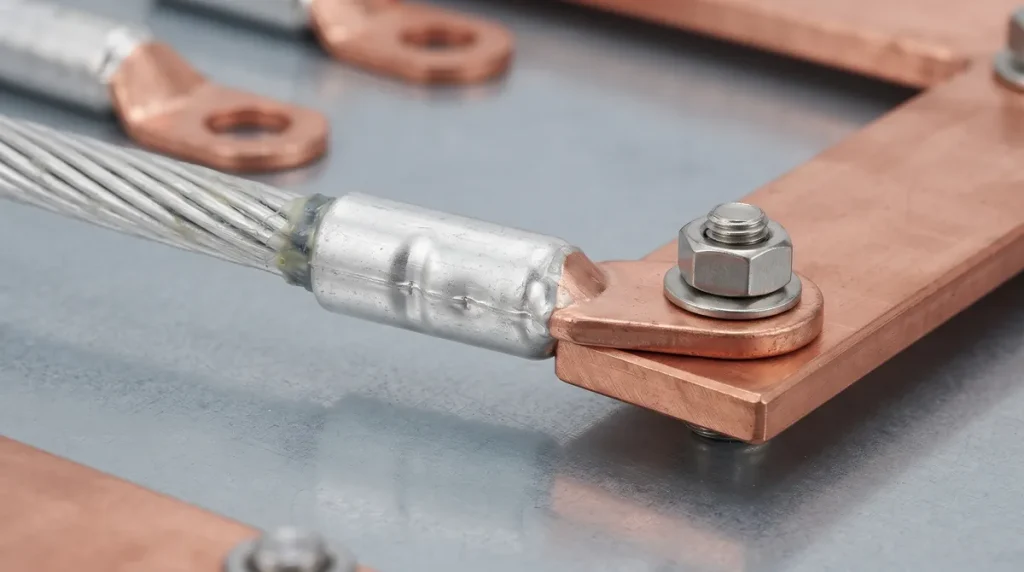
Bimetallic lugs exist to solve one stubborn problem: aluminium cable has to land on a copper terminal, and the two metals do not get along. A bimetallic lug has an aluminium barrel for the cable and a copper palm for the busbar or breaker terminal, joined at the factory. Use one, crimp it properly, and the joint stays cool for decades. Skip it, and the joint heats up, corrodes and eventually fails, often in the middle of a busy week.
This guide explains why the problem happens, how to pick the right bimetallic lug by cable size and bolt size, which crimping die goes with it, how to terminate it step by step, and the errors that cause most of the failed terminations we hear about from Hyderabad sites. It is written for electricians, panel builders and contractors, but a purchase manager will find the checklist near the end useful too.
Why aluminium cable on copper terminals needs bimetallic lugs
Aluminium cable is widely used for incomers and sub-mains because it is much lighter and cheaper than copper for the same current. Most switchgear, busbars and breaker terminals, however, are copper or tin-plated copper. So sooner or later aluminium meets copper at a bolted joint.
Put those two metals in contact in the presence of moisture and you get galvanic corrosion. Aluminium sits far from copper on the electrochemical series, so it behaves as the sacrificial metal and slowly eats away, with the difference in potential being around 2 volts between the two. Hyderabad’s humid monsoon months, and the condensation in poorly ventilated panel rooms, give the moisture. The corrosion product, aluminium oxide, is a poor conductor. The joint resistance goes up, the joint heats, the heat accelerates the corrosion, and the cycle repeats until the cable discolours, melts its insulation, or burns the terminal.
A second effect makes it worse. Aluminium and copper expand at different rates when they heat and cool, and aluminium creeps under steady pressure. A plain bolted joint between the two loosens over time, which again raises resistance.
A bimetallic lug moves the aluminium-to-copper junction away from your terminal and into a factory-made, sealed weld. Your cable goes into the aluminium barrel, so it is aluminium on aluminium. Your terminal sees the copper palm, so it is copper on copper. The dissimilar joint is made once, under controlled conditions, inside the lug itself.
How a bimetallic lug is made
The two common production methods are friction welding and flash butt welding. Both join a copper palm to an aluminium barrel across a solid, gap-free interface. A good bimetallic lug is a single piece in service. You should not be able to see a seam that opens or a gap that lets moisture in.
That is also why cheap lookalikes are risky. Some products are an aluminium barrel with a thin copper plating or a mechanically pressed copper sleeve, which is not the same thing. Check the lug on the bench: look for a clean weld line, a flat palm, and clear marking of the size. If the supplier cannot say how the two halves are joined, that is your answer.
Standards that apply
For lugs and terminal ends, Indian practice refers to IS 8309 for compression-type tubular terminal ends for aluminium conductors. Crimped connectors for power cables are covered by the IEC 61238-1 family internationally, which sets mechanical and electrical tests including heat-cycling. Ask your supplier which standard the product was made and tested to, and whether a test report exists. A lug marked with its cable size, and carrying a manufacturer’s identification, is a better sign than a plain unmarked piece.
The cable’s own construction matters too, because it decides barrel size: aluminium conductors are available as compacted circular and sector-shaped forms, and a lug sized for one may not suit the other. If you are unsure, check the conductor type on the cable drum label.
Sizing a bimetallic lug: cable size and bolt size
You need two numbers before you order. The first is the conductor cross-section in sq mm. The second is the bolt or stud diameter on the terminal, which decides the palm hole.
The barrel must match the conductor. A lug for a 120 sq mm cable has a bore sized for 120 sq mm. A barrel that is too large leaves air gaps after crimping, and a joint with gaps carries less current and runs hotter. A barrel too small will not take the strands at all.
The palm hole must match the bolt, with a little clearance. Use the table below as a rough guide only. Typical bolt sizes are shown for common cable sizes, but the correct hole depends on the actual device, so check the terminal on your breaker, busbar or panel before ordering.
| Aluminium cable size | Typical bolt size on terminal | Notes |
|---|---|---|
| 25 to 35 sq mm | M6 or M8 | Small MCCB and contactor terminals |
| 50 to 70 sq mm | M8 or M10 | MCCB incomers, small sub-mains |
| 95 to 120 sq mm | M10 or M12 | Larger MCCBs, panel incomers |
| 150 to 185 sq mm | M12 | Main LT panels, bus connections |
| 240 to 300 sq mm | M12 or M16 | Heavy feeders; often two-hole palm |
| 400 sq mm and above | M16 and larger | Check device drawing; two-hole palms common |
These pairings are typical, not universal. Treat the table as a starting point and always confirm against the equipment’s own terminal drawing.
Palm shape and barrel length
Lugs come with a single-hole palm for small and medium work and a two-hole palm for large cables, where two bolts spread the contact pressure and reduce the chance of rotation. Barrels come in short and long versions. A longer barrel gives more crimp length, which means more crimping points and a stronger, lower-resistance grip on the conductor. For heavy feeders, or where vibration is present, a long-barrel type is the safer pick.
Match the crimping die to the lug
A bimetallic lug is only as good as its crimp, and the crimp depends on using the right die in the right tool. Aluminium is soft and deforms easily, so a die that is too large leaves the strands loose and one that is too small squeezes metal out of the barrel and weakens it.
Use hexagonal crimps for compression lugs. They compress the barrel evenly all round, and most manufacturers specify them. Take the die size from the lug maker’s data, which is usually printed on the barrel or the packing. Dies are marked by size, and the die number for a lug is typically close to its cable size, but do not assume. Read the chart.
Tool choice follows the cable size. Hand tools handle small cable. Hydraulic tools are needed from the mid range upward, and they are the only practical option for large aluminium conductors because of the force needed. Our HEX crimping tools come as manual and hydraulic hand tools and foot-operated hydraulic types, covering lugs from 0.5 to 1000 sq mm. Hydraulic tools also give you a repeatable crimp, which is the whole point.
One more point that is often missed. If you use a die made for copper lugs on an aluminium barrel, or the other way round, the result will not be reliable. Match the die to the lug, every time.
How to terminate with a bimetallic lug, step by step
- Isolate and test dead. Treat it as live until your tester says otherwise.
- Strip the cable to the barrel depth plus a few millimetres. Do not nick the strands. A cut strand is a weak point.
- Clean the aluminium conductor with a wire brush or abrasive pad. A thin oxide film forms on aluminium within minutes of exposure and it insulates. Clean right before you insert.
- Apply an oxide-inhibiting compound into the barrel or onto the strands. The jointing compound keeps the oxide from re-forming and seals out moisture. Use a product meant for aluminium.
- Insert the conductor fully into the barrel until it seats at the bottom. Check that all strands are inside.
- Crimp with the correct die, starting at the palm end of the barrel and working toward the cable end, with crimps slightly overlapping the die length. Follow the maker’s number of crimps for the cable size.
- Wipe off excess compound and inspect. The barrel should show clean, even compression with no cracks and no strands bulging out.
- Prepare the mating surface. Keep the copper busbar clean, flat and free of paint and oxide. A tin-plated surface is ideal. Do not use a file that leaves a rough, uneven face.
- Bolt up with the right hardware. Use a flat washer and a spring or disc washer so the joint keeps its pressure through heat cycles. Tighten to the torque the equipment maker specifies, using a torque wrench. Do not guess, and do not over-tighten, because crushing a soft palm is as bad as leaving it loose.
- Insulate the barrel. Heat-shrink sleeving over the barrel keeps moisture out and gives you phase colour identification, which also helps the next person to open the panel.
The mistakes that cause failed terminations
Using a plain aluminium lug on a copper terminal. This is the classic one. It looks fine on the day. It is the reason you get a call eight months later about a burnt connection.
Using a copper lug on aluminium cable. It moves the problem into the barrel, where the cable strands are, and it is just as bad.
Skipping the cleaning and compound. Oxide forms fast. The compound is cheap compared to the cost of a failed joint.
Wrong die or a hand-squeezed crimp. A crimp done with pliers or a hammer is not a crimp. It looks tight but has no controlled compression.
Over-tightening or under-tightening the bolt. Both raise resistance. Use a torque wrench and the equipment’s specified value.
Mixing washers and stacks. Piling up several flat washers or using brass nuts on a high-current joint adds extra contact surfaces, and each one is another resistance.
Ignoring the sector-shaped conductor. If your cable has shaped conductors, a lug made for round compacted conductors may leave gaps. Check before you buy.
Not re-checking after commissioning. Aluminium creeps. For important terminations, a re-torque check after the first few weeks of load and an occasional thermal scan is cheap insurance.
When you do not need a bimetallic lug
You do not need one when the joint is aluminium to aluminium, such as an aluminium cable bolted to an aluminium busbar or an aluminium-rated terminal. You also do not need one for copper cable on copper terminals. Some modern switchgear terminals are rated for both aluminium and copper conductors directly, with a tunnel-type connector. Check the device’s rating label before assuming you must use a lug. When in doubt, a bimetallic lug on an aluminium cable going to any copper surface is the safe choice.
Also remember that the rule is about dissimilar metals meeting at a bolted face. If your design is copper cable throughout, you are looking at ordinary copper lugs and nothing special.
Bimetallic lug vs ordinary aluminium lug: what to buy
An ordinary aluminium lug is correct when the other end is aluminium or aluminium-compatible. A bimetallic lug is correct whenever the mating surface is copper or plated copper. Our HEX cable lugs range covers aluminium lugs in short barrel, long barrel and two-hole types from 2.5 to 1000 sq mm, with the standards listed on the product page. For bimetallic requirements, send us the cable size, the conductor type and the bolt size, and we will confirm what we can supply.
The wider cable accessories range also includes the glands and crimping tools you will need for a complete termination, and our Polycab wires and cables page lists the cable that goes into those lugs.
A purchase checklist for Hyderabad buyers
- Cable size in sq mm and conductor type (round, compacted or sector).
- Number of cables per phase if you are paralleling.
- Terminal bolt size and palm type (single hole or two hole).
- Barrel length: short or long.
- Quantity per size, plus a few spares. Lugs are cheap, stoppages are not.
- Matching crimp die and tool. Confirm that your hydraulic tool carries the die for that barrel.
- Jointing compound and heat-shrink sleeving in the right colours.
- A supplier who will give you the standard and the maker’s marking.
If you are building a panel for a factory, a pump house or a commercial building, put all the lug sizes on one order sheet. It prevents the last-minute scramble when an electrician finds a size missing at four in the afternoon.
Frequently asked questions
What is a bimetallic lug?
It is a cable terminal with an aluminium barrel and a copper palm, welded together at the factory. The aluminium end takes aluminium cable, and the copper end bolts onto a copper busbar or terminal, so the two metals never touch at your joint.
Why can I not connect aluminium cable directly to a copper terminal?
Aluminium and copper in contact with moisture cause galvanic corrosion, and aluminium also creeps and loosens under load. The joint resistance rises, it heats up, and it can fail. A bimetallic lug prevents this.
Is a bimetallic lug the same as a bi metal lug or bimetal lug?
Yes. Bi metal lug, bimetal lug and bimetallic lug all refer to the same Al-Cu terminal. Bi-metallic connectors and Al-Cu lugs are other names used on drawings and in tenders.
How do I choose the size of a bimetallic lug?
Match the barrel to the conductor cross-section in sq mm, and match the palm hole to the bolt size on the terminal. Also pick short or long barrel and single or double hole palm depending on cable size and duty.
Which crimping tool and die should I use?
Use a hexagonal crimp with the die size the lug maker specifies, and a hydraulic tool for larger aluminium cables. Always match the die to the barrel, never use a copper die on an aluminium barrel.
Do I need jointing compound when crimping aluminium?
Yes. Clean the conductor right before insertion and use an oxide-inhibiting compound, so a new oxide film does not form in the barrel and the joint stays sealed against moisture.
Which standard covers aluminium lugs and terminal ends in India?
IS 8309 covers compression-type tubular terminal ends for aluminium conductors. IEC 61238-1 is the international standard for compression connectors for power cables. Ask the supplier for the standard marking and test information.
Can bimetallic lugs be reused?
No. A crimped lug is deformed and should be cut off and replaced when a cable is re-terminated. Re-crimping a used lug leaves a weak, high-resistance joint.
