
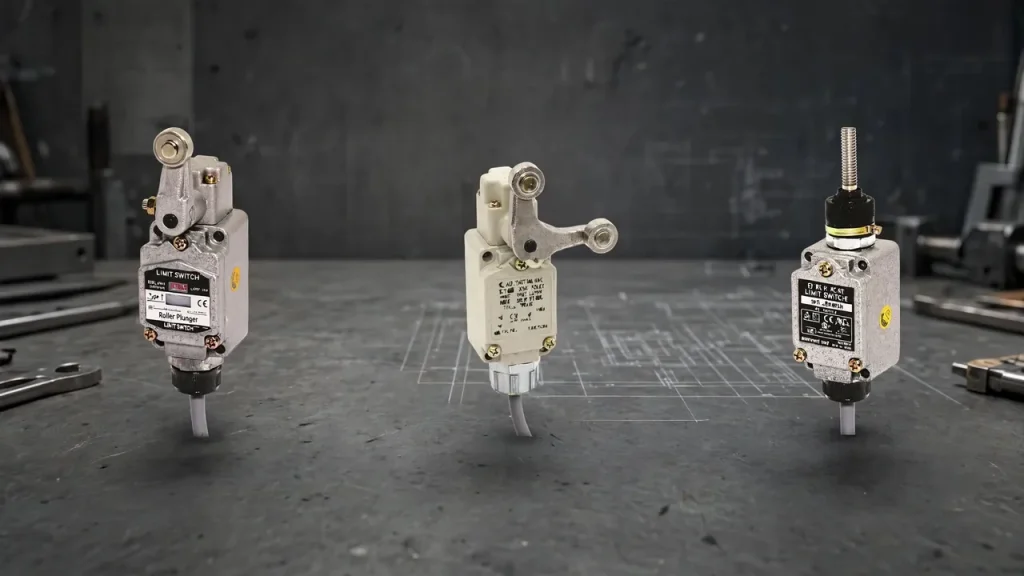
A limit switch is a small switch that tells a machine where something is. A conveyor carriage reaches the end of its travel, a lift car arrives at a floor, a gate hits the fully open position, and a limit switch is the part that notices. It is cheap, it is mechanical, and when it fails the damage is out of all proportion to its price. If you are choosing a limit switch for a panel or a machine in Hyderabad, the decision is mostly about three things: the actuator type, the housing and ingress protection (IP) rating, and how you wire it.
This guide covers all three. It starts with what a limit switch does, goes through roller lever, plunger and whisker actuators with the jobs each suits, explains the ratings worth reading on a datasheet, and ends with the wiring mistake that burns contacts more often than any fault in the part itself.
What a limit switch does, and where it sits in the circuit
A limit switch (also called a position switch or travel switch) converts physical contact into an electrical signal. A moving part presses an actuator, the actuator moves an internal mechanism, and a contact block changes state. That is all. Like a push button, the limit switch is a control device. It normally switches a low-current signal, either to a PLC input or to the coil of a contactor or relay, rather than carrying the motor current itself.
Typical jobs:
- Stopping a motor at the end of travel on a gate, hoist, shutter or sliding door.
- Detecting a part present on a conveyor or fixture.
- Confirming a guard door is closed before a machine can start.
- Counting or sequencing steps in a machine cycle.
The relevant product standard is IEC 60947-5-1 (control circuit devices and switching elements), which in India is covered by the matching IS series. It sets how the contacts are tested, rated and marked. For safety duty, such as a guard interlock, it also defines positive opening operation. That detail matters, and we come to it below.
Choose the actuator first
The actuator is the part that touches the moving machine. Most selection mistakes happen here, because the switch body can be perfect and still fail if the actuator does not suit the way the target arrives. Ask three questions about the target. How does it approach (straight on, from the side, from either direction)? How fast does it move? And is the stopping position precise or loose?
Plunger (pin or push) actuator
A plunger is a short, spring-loaded pin that the target presses straight down onto. It is the most accurate type because the operating point is repeatable to a fraction of a millimetre. Use it when the target arrives in a straight line, along the axis of the pin, and stops at a defined point. Good fits are a part-present check on a fixture, a cam on a rotating shaft, and a short-travel stopper.
Its weakness is side load. A plunger that is hit from the side wears the guide and eventually jams. If the target can arrive at an angle or at speed, a plunger is the wrong choice. A roller plunger, with a small wheel on top of the pin, handles a sliding cam better than a flat-topped pin.
Roller lever actuator
A roller lever is the workhorse of the family. A lever arm carries a roller at its tip, so a sliding cam or moving carriage can roll over it instead of scraping it. It tolerates approach from the side and works with moderate speeds. The roller also reduces wear on both the switch and the cam.
Options to look for:
- Unidirectional (one-way) roller: the lever operates in one direction and rides over in the other. Useful where the carriage must pass the switch on the way back without triggering it.
- Adjustable lever length: lets you set the switching point on site with a few turns of a screw, instead of re-machining the cam.
- Roller material: steel for hard-wearing duty, plastic or rubber for quiet operation and less cam damage.
A roller lever is the usual first pick for gates, shutters, conveyors and lifts, because it forgives small errors in alignment.
Whisker (cat’s whisker or spring rod) actuator
A whisker is a thin, flexible wire or coiled spring that the target brushes past. It operates at tiny forces and works from almost any direction. That makes it good for detecting light or irregular objects such as cartons, bags and small parts on a conveyor, where the exact position of each item varies.
It is the wrong tool for anything that needs precision, because the operating point shifts with angle and speed. It is also a poor choice around heavy or sharp loads that could bend or cut the wire. Use it for presence detection, not for exact stops.
Other actuators you may meet
- Adjustable rod lever: a rod you can cut or set to length, which gives a wide reach for targets at awkward distances.
- Fork lever: latches in one position until pushed back from the other side. Handy for simple two-way detection of a moving part.
- Rotary or shaft-only versions: take your own lever or cam and give you full freedom of design.
Snap action or slow action contacts
Inside the body, the contacts switch in one of two ways. In a snap-action block, the contacts jump quickly from one state to the other once the actuator reaches a trip point, no matter how slowly the target moves. This gives a clean, fast break and is the standard choice for general use. In a slow-action (creep) block, the contacts move at the same speed as the actuator. They suit very slow targets, but a slow break is hard on the contacts when switching an inductive load, because the arc lasts longer.
If your machine moves slowly and the load is a contactor coil, choose snap action. Use slow action only when the circuit needs the contact to follow the actuator position gradually, which is uncommon.
Positive opening, and why safety duty is different
On a standard switch, the contact is opened by a return spring. If the contact welds shut from a bad overload, the spring may not be strong enough to pull it apart, and the circuit stays closed. A limit switch with positive opening operation, often marked with a small symbol of an arrow inside a circle, has a mechanical link between the actuator and the normally closed contact. When the actuator moves, it forces the contact open directly, even if it has welded.
For ordinary end-of-travel signalling this is a nice extra. For a guard door interlock or an emergency end-limit on a lift, it is required. If the switch is part of a safety function, do not treat it as an ordinary switch. Buy one that states positive opening, wire the safety contact as normally closed, and follow the machine’s risk assessment. If you are unsure, bring the drawing to the counter before buying.
Housing, IP rating and temperature
The housing decides how long the switch lives in the real environment.
- Metal die-cast housing: robust, takes knocks and some heat. Good for heavy industrial areas.
- Plastic (thermoplastic) housing: lighter, does not corrode, often fine for indoor panels and food or chemical areas, but easier to crack.
- Stainless steel housing: for washdown, marine and food-processing environments.
For ingress protection, IP65 is a practical minimum for a factory floor, and IP67 is common on industrial limit switches built for dust, oil mist and occasional immersion. Use IP67 for outdoor gates, car wash areas, pump houses and anything near water. A dry indoor lift machine room is gentler on the switch, but it can still be dusty.
Check the cable entry. Most industrial bodies use a conduit thread (commonly M20 or a PG size) that takes a cable gland. A rated switch with an open or badly sealed entry is no longer a rated switch. A properly sized gland closes the gap, and our control panel accessories buyer’s checklist explains how to pick one along with the other items that make up a panel.
Also look at the operating temperature range on the datasheet. Machines near furnaces, boilers and rooftop panels in a Hyderabad summer see conditions well past a comfortable room. Standard switches are fine for ordinary ranges, but a hot environment needs one that states a higher limit.
Reading the electrical rating
The datasheet shows a rated current at a rated voltage, together with a utilisation category. For control circuits, the two you will see most are AC-15 (electromagnetic loads on AC, such as contactor and relay coils) and DC-13 (the same on DC). A typical industrial limit switch might be rated around 3 to 6 A at 240 V AC-15, but read the actual datasheet for your part. The category matters because switching a coil is harder on the contacts than switching a plain resistive load. A rating for a heater does not tell you how long the switch will last on a coil.
The number of contacts also matters: 1NO + 1NC is the common arrangement. The NC contact is what you wire for a stop function, for the same fail-safe reason as a push button. If a wire breaks, the circuit opens and the machine stops.
If the switch feeds a PLC input at 24 V DC and only a few milliamps, plain silver contacts can form a surface film and read unreliably. Look for gold-plated or low-level contacts, or choose a sealed type designed for electronic loads.
The wiring mistake that burns contacts
The most common failure is not a bad switch. It is a good switch used to switch the wrong thing. Here is how it happens.
An installer wires the limit switch in series with the motor, or in series with a large contactor coil without any suppression, and the contacts open on an inductive load. Every time they open, the collapsing magnetic field produces an arc across the contacts. Over a few thousand operations, the contacts pit, weld or burn black. The symptom is a switch that works for a month and then sticks, or a gate that overruns because the stop contact will not open.
The fixes are plain and cheap:
- Switch the control circuit, not the power. The limit switch should drive a relay or a contactor coil, never the motor itself.
- Suppress the coil. Fit an RC snubber or a varistor across an AC contactor coil, and a flyback diode across a DC coil. This takes the sting out of the arc.
- Respect the rating. Compare the coil’s inrush current to the AC-15 rating, not just its steady current.
- Do not parallel two switches to get a higher current rating. They never share evenly, so one still takes the full load.
- Use an interposing relay where the load is bigger than the switch. A small relay does the arcing, and the limit switch only drives the relay.
The second most common mistake is mechanical. The target travels past the trip point and hits the switch body, because nobody left enough overtravel. Every limit switch has a stated overtravel allowance after the contacts operate. Set the cam or the stop so that the target comes to rest inside that allowance, not at the end of it. A switch crushed at the end of every cycle will not last.
Choosing for a real job: three short examples
A sliding gate. The gate carriage moves slowly, from either direction, on a track outdoors. Choose a roller lever with a metal IP67 housing, set at each end of travel, with a snap-action 1NO + 1NC block. Wire the NC contact to cut the motor contactor coil at each end. Put an RC snubber across the coil. Leave an overtravel margin so the carriage settles before reaching the end of the switch’s stroke.
A carton on a conveyor. The cartons vary in size and wobble. A whisker actuator, mounted at the side of the belt, will detect them with very little force. A precise plunger would jam on an uneven carton. This is presence detection, so IP65 is enough indoors.
A part-present check on a machine fixture. The part drops straight onto a seat. A plunger gives the repeatable trip point you need. Choose a plunger with a hardened tip, and mount it so the load arrives along the pin axis, not at an angle.
Where limit switches fit with motors and starters
Limit switches almost always sit in front of a motor starter. The contactor, overload relay and protection devices do the work, and the limit switch decides when the machine should stop or start. If you are building or repairing the power side of the circuit as well, browse the switchgear range for contactors and overload relays, and the ABB motors range for the machine itself. The supporting parts for panel work, including glands, terminal blocks and enclosures, are listed under panel accessories.
When you enquire, give the supplier the information that saves a second trip: the actuator style, the housing material, the contact arrangement, the control voltage, the IP rating and the cable entry thread. If you are replacing an existing switch, note the maker and model on the label, or bring the old one in. Mounting dimensions differ between families, and a switch that is “about the same” is the one that misses the bolt holes by 3 mm.
A short checklist before you buy
- How does the target arrive: straight on, from the side or loosely?
- Do you need exact position (plunger or roller) or just presence (whisker)?
- Is this a safety function that needs positive opening?
- What IP rating does the place need, and what housing material?
- What is the control voltage and the load type (coil or PLC input)?
- How many contacts, and is the stop wired normally closed?
- Is there an RC snubber or diode on the coil?
- Have you left room for overtravel?
Frequently asked questions
What is a limit switch used for?
It detects the position of a moving part and sends a signal to a controller or contactor. Common uses are end-of-travel stops on gates and lifts, part-present checks, guard door interlocks and conveyor detection.
Which limit switch actuator should I choose?
Use a plunger for precise, straight-on contact. Use a roller lever for sliding cams and general machinery where the approach is not perfect. Use a whisker for light or irregular objects where only presence matters.
What is the difference between a limit switch and a proximity sensor?
A limit switch needs physical contact and switches a mechanical contact. A proximity sensor detects a target without touching it. Limit switches are simple, work on any voltage and give a clear mechanical contact. Proximity sensors have no moving parts and suit high-speed counting.
What IP rating do I need for a limit switch?
IP65 is the minimum for a factory floor. Choose IP67 for outdoor gates, washdown areas and pump houses. A rated housing also needs a sealed cable entry.
What does positive opening mean on a limit switch?
It means the actuator mechanically forces the normally closed contact open, even if the contact has welded. It is required for safety functions such as guard interlocks, defined in IEC 60947-5-1.
Why do limit switch contacts burn out?
Usually because the switch is breaking an inductive load, such as a contactor coil, without suppression. Each opening makes an arc that pits the contacts. Fit an RC snubber or varistor on AC coils and a diode on DC coils, and switch only the control circuit.
Can I use a limit switch to stop a motor directly?
You should not. The limit switch should drive a contactor or relay that switches the motor. Direct switching of motor current exceeds the control-contact rating and destroys the switch quickly.
How do I wire a limit switch to a PLC?
Connect the common to the supply, and the NO or NC contact to the input, matching the PLC’s input voltage (usually 24 V DC). Use a low-level or gold-plated contact if the current is only a few milliamps, and keep the signal cable away from power cables.
