
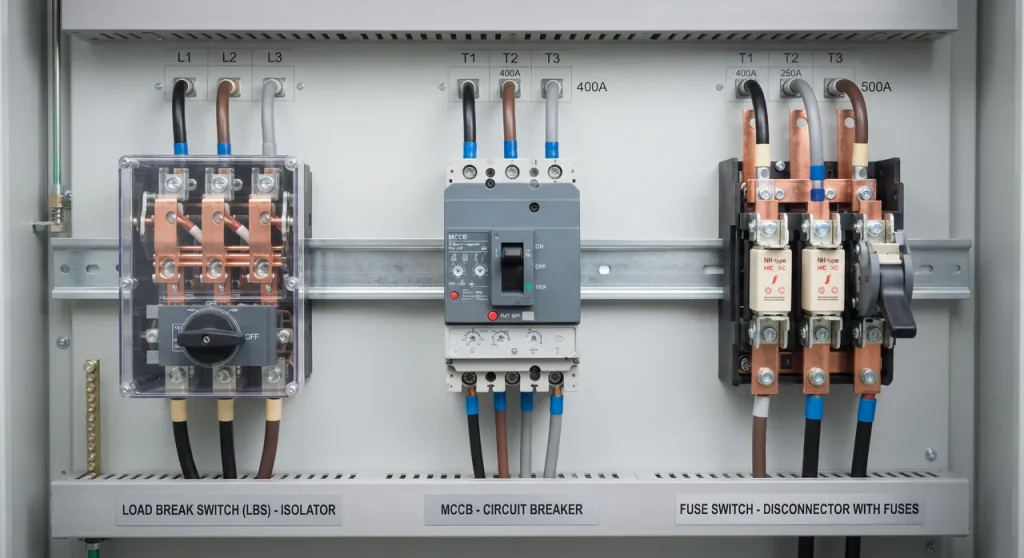
A load break switch does one job that a lot of buyers misunderstand. It switches a live load on and off, and it isolates a circuit so someone can work downstream. It does not protect that circuit from an overload or a short circuit. People who forget that end up either over-spending on an MCCB where a switch would do, or worse, putting a switch where a breaker was needed. This guide sets out what a load break switch can and cannot do, how it differs from an MCCB, an isolator and a switch fuse unit, and how to pick the right rating for a plant in Hyderabad.
If you are still deciding between MCBs and MCCBs for protection, that is a different question, and we answer it in the ABB MCB vs MCCB guide. This page is about switching and isolation duty.
What a load break switch does
A load break switch (LBS), also called a switch-disconnector, has three jobs:
- Make and break normal load current safely, including the starting current of a motor, depending on its rating.
- Isolate. In the open position it leaves a visible or positively indicated gap in the contacts, wide enough that a person can work on the downstream side with confidence. This is the “disconnector” part of the name.
- Close onto a fault without welding. A good switch is tested to survive being closed onto a short circuit, even though it cannot open one.
What it does not do is trip automatically. There is no thermal element and no magnetic element. If the load draws too much current, the switch just carries it until something upstream or a fuse deals with it. This is the fundamental difference from a circuit breaker.
The standard behind it: IEC 60947-3
In India, load break switches, isolators and switch-fuse combinations are covered by IS/IEC 60947-3, which is the low-voltage standard for switches, disconnectors, switch-disconnectors and fuse-combination units. The standard sorts switches by utilization category, and this is the part you must read on the nameplate before you buy.
- AC-21A / AC-21B: switching resistive loads, including a modest overload. Good for heaters and distribution feeds where nothing inductive is switched.
- AC-22A / AC-22B: mixed resistive and inductive loads, including a moderate overload.
- AC-23A / AC-23B: motor loads and other highly inductive loads. This is the one you need if the switch will be breaking a motor circuit.
The “A” means frequent operation. The “B” means infrequent operation. A switch rated AC-23B is built for occasional use, such as a maintenance isolator, and is not meant to be flicked on and off many times a day. If your application operates often, ask for the A version.
A common mistake is to read only the ampere rating and ignore the category. A switch marked 63 A at AC-21 may carry only a smaller current at AC-23 when switching a motor. Always check the rating at the category that matches your load.
Load break switch vs MCCB: the real difference
An MCCB (moulded case circuit breaker) is a protective device. It senses overload and short circuit and opens by itself, and it can also be switched by hand. A load break switch is a switching and isolation device with no sensing. Think of it this way.
- An MCCB protects the cable and the equipment. An LBS switches and isolates.
- An MCCB breaks fault current. An LBS cannot, so it must be backed by a fuse or a breaker upstream.
- An MCCB costs more for the same current rating, because of its trip unit and its fault-breaking capability. For a main switch or a plain isolator on a feed that is already protected, a switch is the cheaper and perfectly correct choice.
- An MCCB can also give you isolation if it is marked as suitable for isolation, but many installers prefer a dedicated switch-disconnector on the incomer so the isolation point is obvious.
Pair the two. An MCCB or fuse protects. A load break switch in front of or beside it gives you a clean way to switch off and lock off. Plenty of panels use exactly that: switch-disconnector on the incomer for isolation, MCCBs on the outgoing feeders for protection.
Load break switch vs isolator vs switch fuse unit
These three get mixed up on purchase orders. Here is how they differ.
Isolator (disconnector)
A plain isolator is built to open a circuit that is already de-energised or carrying negligible current. It provides the isolating gap but is not rated to break load. Use it where another device always switches the load first. Opening an isolator under load can cause a dangerous arc, which is why many are interlocked with a breaker. When someone says “isolator” in an Indian plant they often mean a load break switch, so confirm the category on the rating plate and not the word on the order.
Load break switch (switch-disconnector)
Rated to make and break load and to isolate. No overcurrent protection. Used as the main switch, as a motor isolator beside the machine, and on outgoing feeders where protection sits elsewhere.
Switch fuse unit (SFU) or fuse switch unit (FSU)
This is a load break switch combined with HRC fuses (IEC 60269 / IS 13703). The switch handles making, breaking and isolation. The fuses handle overload and short circuit. A switch fuse is a good middle path when you want protection and isolation without the cost of an MCCB, and it is extremely common on motor feeders and older distribution boards. A fuse also has very high breaking capacity for its size, which can be an advantage on a site with high fault levels.
The trade-off is the fuse itself. After a fault, a fuse must be replaced, and if only one phase blows on a three-phase motor, the motor can run on two phases and overheat. Many designers add a phase failure relay or choose a breaker for that reason. Use fuses of the right type, and keep spares of each rating on site.
Which one does your plant need?
A quick way to choose. Start from the duty, not the product name.
| Your duty | Pick | Why |
|---|---|---|
| Main switch on a panel incomer, protection upstream | Load break switch | Isolation and manual switching, no need to pay for a trip unit |
| Local isolator beside a motor for maintenance | Load break switch, AC-23 | Operator can lock off and see the gap before touching the motor |
| Feeder needing overload and short-circuit protection with isolation | Switch fuse unit or MCCB | Fuses suit high fault levels; MCCB suits resettable, adjustable protection |
| Feeder where you want to reset after a trip without changing parts | MCCB | No consumables, adjustable trip settings |
| Circuit already de-energised by another device | Isolator | Cheapest way to get a visible gap |
Reading the rating: what to check before you buy
- Rated current (Ie) at the utilization category you need, not just the headline ampere.
- Number of poles. Three-pole for a three-phase load. Four-pole where the neutral must also be switched, such as when a generator and mains share a changeover and you need to avoid a neutral loop. Most industrial supply is three-pole plus a solid neutral link, so check your earthing arrangement before you add the fourth pole.
- Rated voltage. 415 V for most Indian industrial three-phase work.
- Short-circuit making capacity and short-time withstand (Icw). This tells you how much fault current the switch can survive when closed, until the upstream device clears it. Match it to the fault level at the point of installation.
- Fuse size, for an SFU. The unit is built for a maximum fuse rating, and your fuse must not exceed it.
- Enclosure and IP rating. A switch in a dusty workshop or outdoors needs a proper enclosure. Check the door interlock and whether it can be padlocked in the off position.
- Operating handle. Direct-mounted, door-coupled rotary, or extension shaft. A door-coupled handle that lets the panel door open only when the switch is off is a real safety gain.
Mistakes we see on site
- Using a switch as the only protection. There is no overload or short-circuit tripping. Something upstream must protect the cable.
- Reading the ampere and ignoring the category. A switch that is happy on a heater can be too small for a motor of the same current.
- Calling it an isolator and buying an isolator. If the switch must break load, say so on the order.
- Oversized fuses in a switch fuse unit. The fuse must suit the cable and the load, not just fit the holder.
- No lock-off. If maintenance staff cannot padlock the switch off, the isolation is only as good as everyone’s memory.
- Ignoring the fault level. A switch with a low short-time rating on a high fault-level incomer is a hazard, even when the ampere rating looks right.
- Mixing the brand of switch and enclosure carelessly. Terminals, handles and shafts are made to fit a particular range. Mix them and you will fight alignment problems.
Sizing a load break switch for a motor
Motors are where most wrong purchases happen, because a motor draws several times its running current at start. A switch used on a motor feeder should be rated at AC-23, and its rated current at that category should be at least the motor’s full-load current. As a working habit, many electricians pick the switch one step up from the motor current to leave headroom for ageing contacts and hot panels. That is a rule of thumb, not a substitute for the maker’s table.
Take a three-phase 15 kW motor on 415 V. Full-load current is roughly 28 to 30 A depending on efficiency and power factor, and the exact value is on the motor nameplate. A switch rated 40 A at AC-23 would be a sensible starting point. The protection is then handled by the starter’s overload relay and a short-circuit device, either HRC fuses in a switch fuse unit or an MCCB upstream. The switch itself is the “off” button that lets the maintenance team work safely.
Do not use the nameplate kilowatt figure alone. Start from the full-load current on the motor and check the duty: how often it starts, whether it is reversing, whether it plugs to a stop. Frequent starting and reversing push the duty beyond what an AC-23B switch is built for.
Lock-out and tag-out: the reason isolation matters
The point of the isolating gap is that someone can safely work on the other side. For that to be true in practice, the switch needs a way to be locked in the open position. Look for a padlock facility on the handle, ideally accepting more than one padlock so that several maintenance people can each add their own. The panel procedure then becomes simple: switch off, lock, tag, test for dead, work. Without the lock, the isolation depends on nobody else walking up and switching it back on.
Testing for dead is part of the process, even after isolating. The switch tells you the contacts are open. A test instrument tells you the cable is dead. Do both.
Installation and upkeep checks
- Tighten the terminals to the torque on the data sheet. Loose terminals on a switch carrying heavy current heat up, and heat is what eventually damages a contact.
- Use the right cable lug size, not a smaller lug forced onto a larger terminal.
- Operate the handle a few times when commissioning. It should move with a firm, positive snap. A sluggish switch should be returned, not installed.
- Inspect periodically. Look for discolouration, burnt smell, cracked covers or pitted contacts. A thermal image of the panel during a normal load check will show a hot terminal long before it fails.
- Keep the fuse spares matched. In a switch fuse unit, replace all three fuses together after a blow, from the same maker and type.
Short answers to what buyers ask us most
Can a load break switch be used as a main switch? Yes, provided there is protection upstream or in the outgoing circuits that covers short circuit and overload. Can it replace an MCCB? Only if something else provides the protection. Can it open on a short circuit? No. It can close onto one without welding, which is a different thing. Is a switch fuse the same as a load break switch? Not quite. A switch fuse unit is a load break switch fitted with fuses, so it also protects. Is an isolator the same as a load break switch? Only if the isolator is rated to make and break load. Read the category.
Medium-voltage load break switches are a different product
You may also see “load break switch” used for 11 kV and 33 kV equipment, such as ring main units and pole-mounted switches on utility lines. Those follow a different standard (IEC 62271-103) and are specified by utility and substation requirements. This guide covers low-voltage industrial switches up to 415 V. If you need medium-voltage equipment, tell us your voltage level at the start of the enquiry so we can say clearly what we can and cannot quote.
Where to buy in Hyderabad
We supply switchgear from established manufacturers to panel builders, contractors, factories and commercial buildings across Hyderabad, Telangana and Andhra Pradesh. You can browse the ABB switchgear range and the Legrand switchgear range, and our switchgear buyer’s guide explains how the rest of the range fits together. If you are not sure which of the three types you need, send us your load, your supply voltage and the protection already in the circuit, and we will tell you in plain words which one fits. Use the enquiry page to start.
Pricing depends on the rating, pole count, brand and whether the unit comes with fuses and an enclosure, so we quote against your details rather than print a list here.
Summary
A load break switch switches and isolates. It does not protect. An MCCB protects and can also switch. A switch fuse unit gives you both, using fuses for the protection. Read the utilization category, check the short-time withstand against your fault level, and make sure something upstream always handles overload and short circuit. Get those right and you will buy the cheapest device that does the job safely.
Frequently asked questions
What is a load break switch?
A load break switch, also called a switch-disconnector, is a device that makes and breaks normal load current and isolates a circuit for safe work. It has no overload or short-circuit tripping.
Can a load break switch protect against short circuit?
No. It can be closed onto a short circuit without welding, but it cannot open one. Protection must come from fuses or a circuit breaker upstream, or from fuses in a switch fuse unit.
What is the difference between a load break switch and an MCCB?
An MCCB senses overload and short circuit and trips automatically. A load break switch only switches and isolates. An MCCB protects the cable and equipment, a switch does not.
What is the difference between an isolator and a load break switch?
A plain isolator is meant to open a circuit that is already off or carries negligible current. A load break switch is rated to make and break load. Check the utilization category on the rating plate.
What does AC-23 mean on a switch?
AC-23 is the utilization category under IEC 60947-3 for switching motor loads and other highly inductive loads. Choose it when the switch will break a motor circuit, and read the ampere rating at that category.
What is a switch fuse unit?
A switch fuse unit is a load break switch fitted with HRC fuses. The switch handles on and off and isolation, and the fuses provide overload and short-circuit protection.
