
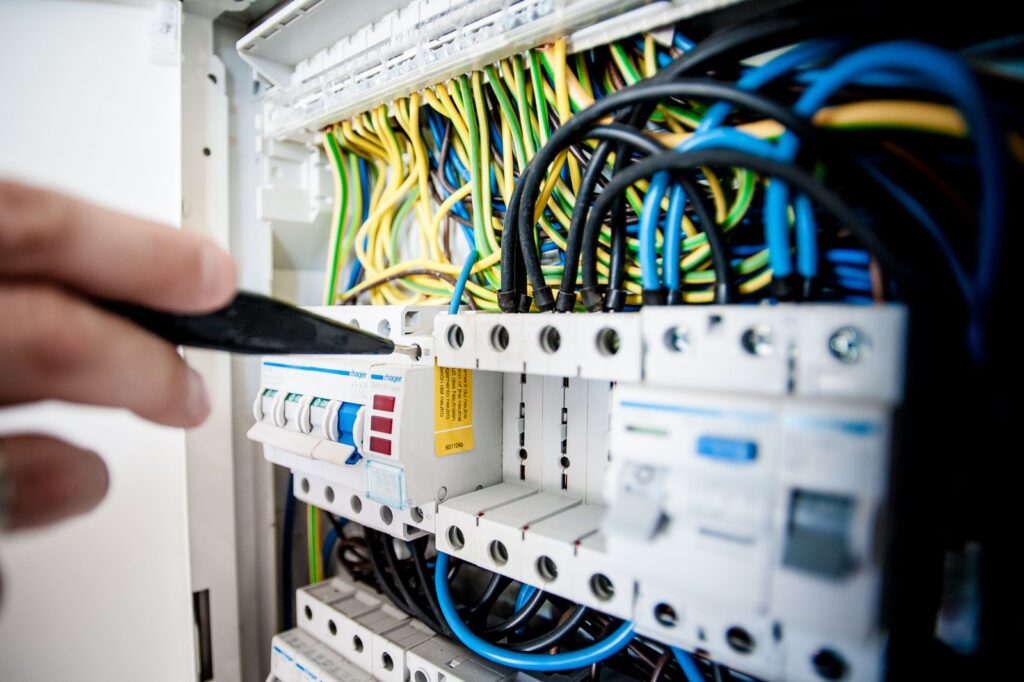
What Is Switchgear? (Definition and Role)
Switchgear is the set of electrical devices – circuit breakers, switches, fuses, and isolators – used to control, protect, and isolate electrical equipment and circuits. Every electrical installation, from a single flat to a factory, needs switchgear to work safely. Switchgear does three jobs:- Control – switching a circuit on or off, either manually (an isolator) or automatically (a breaker responding to a signal).
- Protect – detecting an overload, short-circuit, or earth-leakage fault and disconnecting the circuit before it causes damage, fire, or injury.
- Isolate – providing a safe, visible break in a circuit so equipment can be serviced or repaired without risk of electric shock.
Types of Switchgear Explained
There isn’t one type of switchgear that fits every job – each type is built for a different current range and a different kind of fault. Here’s what each one does, in the order you’ll typically encounter them from a household socket up to an industrial main panel.MCB (Miniature Circuit Breaker)
An MCB protects low-current circuits – typically up to 100A – against overload and short-circuit, and is the most common switchgear device in Indian homes and light-commercial wiring. It trips automatically when current exceeds its rated value and can be manually reset (unlike a fuse, which has to be replaced). MCBs come in single-pole (SP), double-pole (DP), triple-pole (TP), and four-pole (FP) configurations depending on whether they’re protecting a single-phase or three-phase circuit. Quick Answer: Use an MCB for lighting circuits, socket outlets, and individual appliance circuits in homes, shops, and small offices — anywhere the load is under 100A per circuit. Worked example: a typical 3BHK flat splits its load across several MCB-protected circuits rather than one – lighting, general sockets, kitchen appliances, and air conditioning each get their own MCB, sized to that circuit’s specific connected load rather than the flat’s total load. This is why “what size MCB do I need” doesn’t have one universal answer it – depends on which circuit, and what’s on it. MCBs are also classified by trip curve (Type B, C, or D) depending on whether the circuit has resistive loads like lighting (Type B) or inductive/motor loads like AC compressors and pumps (Type C or D) – using the wrong curve causes nuisance tripping on motor start-up current even when the wiring itself is fine.MCCB (Moulded Case Circuit Breaker)
MCCBs handle higher currents – up to 1,600A and above – with adjustable trip settings, making them the standard choice for larger commercial and industrial loads where an MCB’s fixed rating isn’t enough. Because the trip current, and often the trip time, can be adjusted on-site, MCCBs let an electrician tune protection to the actual load without swapping the device. Quick Answer: Use an MCCB for main incoming supply to a commercial building, industrial machinery feeders, or any panel where the load exceeds MCB range or needs adjustable protection. MCCBs are also specified by their interrupting/breaking capacity – how much fault current they can safely clear without failing — which matters more as building size and transformer capacity increase. A panel builder or consulting electrical engineer typically calculates the available fault current at each point in the installation and selects an MCCB breaking capacity to match, which is one reason MCCB selection for a commercial or industrial site should go through a qualified engineer rather than being picked off a catalogue by rating alone.RCCB (Residual Current Circuit Breaker)
An RCCB protects people, not equipment – it detects a leakage current to earth (as small as 30mA) and disconnects the circuit before it causes electric shock. It doesn’t protect against overload or short-circuit on its own, which is why it’s normally installed alongside MCBs, not instead of them. Quick Answer: An RCCB is essential wherever there’s human contact risk – bathrooms, kitchens, outdoor sockets, and increasingly mandated across all new residential wiring per IS 8828. RCCBs are rated by sensitivity – 30mA devices are used for direct shock protection on circuits people touch (sockets, bathrooms), while higher-sensitivity 100mA or 300mA devices are sometimes used further upstream for fire protection on larger circuits, where the finer 30mA protection sits closer to the point of use. Getting this layering right – not just fitting “an RCCB” somewhere in the board – is part of what a qualified electrician plans into the distribution board design.RCBO (Residual Current Breaker with Overload protection)
An RCBO combines an MCB and an RCCB in a single device – overload/short-circuit protection plus earth-leakage protection, per circuit, in one unit. RCBOs cost more per circuit than a shared RCCB + MCB setup but mean a leakage fault on one circuit doesn’t trip the whole distribution board. Quick Answer: Choose RCBOs, circuit by circuit, where you want individual leakage protection without losing power to unrelated circuits when one trips – common in higher-spec homes and offices.ACB (Air Circuit Breaker)
ACBs protect high-current circuits – typically 630A to 6,300A – and are used for main incoming panels and industrial installations, where they’re commonly paired with DG (diesel generator) sets for changeover switching and with large distribution boards as the main breaker. Quick Answer: Use an ACB at the main incoming point of an industrial facility or large commercial building, especially anywhere generator changeover or high fault-current interruption is required.Isolators
An isolator only disconnects a circuit manually for safe maintenance – it carries no automatic fault-protection function, unlike an MCB, MCCB, or ACB. Isolators are typically installed alongside a breaker, not instead of one, so a technician can create a visible, lockable break before working on equipment. Quick Answer: Fit an isolator wherever equipment needs to be safely de-energized for maintenance – motor feeders, AC units, and panel sections that need isolated servicing.Distribution Boards (DBs)
A distribution board is the enclosure that houses and organizes MCBs, RCCBs, and RCBOs for a building’s circuits, splitting the incoming supply into individually protected outgoing circuits. DB sizing (number of ways, single- or three-phase, surface- or flush-mounted) depends on how many circuits the installation needs today and room for future additions. Quick Answer: Every home, office, or industrial panel needs a correctly sized distribution board as the hub where all the individual circuit breakers live – undersizing it is the most common mistake we see in new installations.MCB vs MCCB vs RCCB vs ACB – Comparison Table
The four core switchgear types differ mainly by current range and what they protect against – MCBs and MCCBs stop overload/short-circuit at different current scales, RCCBs stop earth-leakage shock, and ACBs handle the highest industrial currents.| Device | Current Rating | Breaking Capacity | Typical Application | Poles Available |
|---|---|---|---|---|
| MCB | Up to 100A | Up to 10kA | Homes, shops, light-commercial | SP, DP, TP, FP |
| MCCB | 16A–1,600A+ | Up to 85kA | Commercial/industrial feeders, machinery | SP, DP, TP, FP (adjustable trip) |
| RCCB | Up to 125A (typically paired with MCB) | N/A (not a fault-current device) | Earth-leakage/shock protection — bathrooms, kitchens, outdoor points | DP, FP |
| ACB | 630A–6,300A | Up to 100kA+ | Main incoming panels, industrial installations, DG-set pairing | TP, FP |
How to Choose the Right Switchgear
Sizing switchgear isn’t about buying the highest-rated device you can afford – an oversized breaker won’t trip when it should, and an undersized one nuisance-trips constantly. Here’s how to think about it for three common situations.For Residential Use
- Calculate the connected load per circuit (lighting, sockets, kitchen/AC) before choosing an MCB rating – don’t guess.
- Use DP MCBs for circuits that need to disconnect both live and neutral; SP is sufficient for most lighting circuits.
- Fit an RCCB (or RCBOs per circuit) on any circuit with bathroom, kitchen, or outdoor exposure – this is close to mandatory under current Indian residential wiring practice.
- Size the distribution board with 2-4 spare ways for future circuits (a second AC, EV charger point, etc.) rather than filling it exactly to today’s need.
- Confirm the specific MCB amperage for your flat or house with a qualified electrician or eNarayan’s technical team – load calculation depends on your actual connected appliances, not a generic figure.
For Commercial/Office Use
Office and retail panels typically step up to MCCBs at the main distribution point, with MCBs still handling individual socket/lighting circuits downstream. RCCBs remain important on any circuit serving pantry, washroom, or exterior points. Because commercial spaces often run continuous loads (HVAC, IT equipment, signage), size the main MCCB with headroom for the building’s actual peak demand, not just its average draw, and confirm trip settings with your installer. A few things commercial buyers get wrong that are worth flagging up front: sizing the main MCCB to today’s tenant fit-out without headroom for a future tenant change; skipping RCCBs on exterior signage or outdoor sockets because “it’s not residential”; and treating the distribution board as a one-time purchase rather than budgeting spare ways for the inevitable next circuit addition. All three are cheap to fix at design time and expensive to fix after installation.For Industrial/Panel-Builder Use
Industrial panels need MCCB or ACB sizing coordinated with the site’s full protection scheme – upstream and downstream devices need to trip in the right sequence so a fault at one machine doesn’t take down the whole panel (a discipline called protection coordination or discrimination). This is specialist work: an industrial panel builder or consulting electrical engineer should size and coordinate ACBs/MCCBs against the site’s single-line diagram, not just pick a rating off a shelf. eNarayan’s technical team can help source the right ABB, Legrand, or Havells lines for a coordinated scheme once your engineer has specified it.Standards and Safety Compliance
Indian switchgear is governed by specific IS/IEC standards, not vague “international standards” language – knowing the actual standard number matters for compliance, insurance, and inspection sign-off.- IS 8828 – governs RCCBs (Residual Current Circuit Breakers) in India, covering earth-leakage trip sensitivity and safety performance.
- IS/IEC 60898 – governs MCBs (Miniature Circuit Breakers) for household and similar installations.
- IS/IEC 60947 – governs MCCBs and ACBs (low-voltage switchgear and controlgear) for industrial and commercial applications.
- BIS certification – switchgear sold in India should carry BIS (Bureau of Indian Standards) certification; all switchgear brands eNarayan stocks – ABB, Legrand, Havells, Anchor by Panasonic, HPL – are BIS-compliant for their Indian product lines.
Brands We Stock — ABB, Legrand, Havells, Anchor by Panasonic, HPL
eNarayan Elex carries switchgear from five manufacturers, so you can compare across brands with one supplier rather than sourcing separately. Here’s what distinguishes each line.ABB
ABB is a global industrial and electrification technology leader, and its low-voltage switchgear range (including the Formula and SDB series MCBs referenced on our ABB switchgear page) is widely specified for both residential and industrial installations in India. ABB’s line is a strong fit where international-standard documentation and industrial-grade reliability matter, particularly for panel-builder and B2B procurement customers.Legrand
Legrand is known for its wide modular and switchgear range covering residential through light-commercial applications, with a strong presence in the Indian market. See our Legrand switchgear page for the specific MCB and distribution board lines we stock — a common choice for homeowners and electricians who want a well-recognized brand with broad local availability.Havells
Havells is one of the most recognized electrical brands in India, with an MCB and distribution board range built specifically for the Indian residential and light-commercial market. Full details are on our Havells switchgear page. Havells is frequently the first brand homeowners ask for by name in Hyderabad and Telangana.Anchor by Panasonic
Anchor, now under Panasonic, combines a long-standing Indian brand heritage with Panasonic’s manufacturing standards. See our Anchor by Panasonic switchgear page — a solid mid-market choice for residential and small-commercial buyers who want reliability at accessible pricing.HPL
HPL is an established Indian switchgear and metering manufacturer with a strong regional presence. Details are on our HPL switchgear page — often selected by cost-conscious commercial and industrial buyers who still want BIS-certified quality. All five brands are stocked and available for both retail and bulk/B2B orders directly from our Hyderabad location – no cross-vendor sourcing delay.Installation and Maintenance Basics
Switchgear installation beyond a simple like-for-like MCB swap should always be done by a licensed electrician — not as a DIY project. Incorrect installation, wrong torque on terminal connections, or an incorrectly rated device can create a fire or shock hazard that the switchgear itself was meant to prevent. Routine maintenance is simple but often skipped:- RCCBs have a built-in test button – press it monthly to confirm the trip mechanism still works; if it doesn’t trip, the device needs replacement.
- MCBs and MCCBs typically last 15-20 years under normal use, but should be inspected sooner if they trip frequently without an obvious cause, feel warm to the touch, or show any visible scorching or damage.
- Distribution boards should be visually inspected periodically for loose connections, corrosion, or signs of overheating, especially in older installations.
Buying Switchgear From eNarayan Elex – Why Hyderabad, Telangana and Andhra Pradesh Businesses Choose Us
eNarayan Elex is an authorized distributor for ABB, Legrand, Havells, Anchor by Panasonic and HPL switchgear – five brands under one roof, which no single comparable dealer in our service area currently offers together. That means you can compare MCB, MCCB, RCCB, and ACB options across brands in one conversation instead of five separate vendor calls, whether you’re a homeowner buying a handful of MCBs or a procurement team placing a bulk industrial order. We serve retail and bulk/B2B customers across Hyderabad, Secunderabad, Rasoolpura, and the wider Telangana and Andhra Pradesh region, with switchgear stocked locally for faster turnaround than ordering direct from a manufacturer. Our technical sales team can help you match the right type and brand to your load – residential, commercial, or industrial — and provide BIS compliance documentation where needed. Get a free quote today – reach our corporate office in Hyderabad by phone or email (details on our contact page), or explore our full switchgear range online.Frequently Asked Questions
What is the difference between MCB and MCCB?
MCB (Miniature Circuit Breaker) protects circuits up to 100A and is used in residential/light-commercial wiring; MCCB (Moulded Case Circuit Breaker) handles higher currents (up to 1,600A+) and is used for larger commercial/industrial loads with adjustable trip settings.
Is an RCCB mandatory for home wiring in India?
Yes — an RCCB (Residual Current Circuit Breaker) is strongly recommended and increasingly required by current electrical wiring practice for earth-leakage/shock protection on new residential installations, per IS 8828.
What size MCB do I need for a 3BHK flat?
The right MCB rating depends on your actual connected load — please confirm the specific amperage with eNarayan’s technical team or a qualified electrician before purchase; we don’t recommend buying based on a generic figure without a load calculation.
Which brand of switchgear is best — ABB, Legrand, or Havells?
All three are BIS-certified and suitable for Indian installations; the right choice depends on budget, the specific line (residential vs industrial-rated), and warranty/service support. eNarayan stocks all three plus Anchor by Panasonic and HPL so you can compare directly.
What is the difference between an isolator and an MCB?
An isolator only disconnects a circuit manually for safe maintenance and carries no fault-protection function; an MCB automatically trips on overload or short-circuit. They serve different purposes and are often installed together.
How often should switchgear be tested or replaced?
RCCBs should be test-button-checked monthly; MCBs/MCCBs typically last 15-20 years under normal use but should be inspected if they trip frequently, feel warm, or show visible damage.
Does eNarayan supply switchgear for bulk/industrial orders in Telangana and Andhra Pradesh?
Yes — eNarayan Elex is an authorized distributor for ABB, Legrand, Havells, Anchor by Panasonic and HPL switchgear across Hyderabad, Telangana and Andhra Pradesh, serving both retail and bulk/B2B orders.
What is an ACB used for?
An Air Circuit Breaker (ACB) protects high-current circuits (typically 630A-6,300A) in industrial installations and main incoming panels, and is commonly paired with DG sets and large distribution boards.
Related Categories
Switchgear rarely works alone in a panel — these related categories are commonly specified alongside it:- Panel Accessories — enclosures, terminal blocks, and busbars that house and connect your switchgear.
- Control Panel Accessories Buyer’s Checklist — what to check before you specify enclosures, terminal blocks and busbars for a panel build.
- Numeric UPS VA Rating Sizing Guide — size the right UPS backup for a panel or site once the switchgear is specified.
- Visit Us in Secunderabad — pick up switchgear in person at our retail outlet near Begumpet.
- Digital Meters — energy metering that pairs with distribution boards for consumption tracking.
- Earthing & Lightning Protection — RCCBs and earthing systems are designed to work together for shock protection.
- DG Sets — ACBs are commonly paired with generators for changeover switching.
