
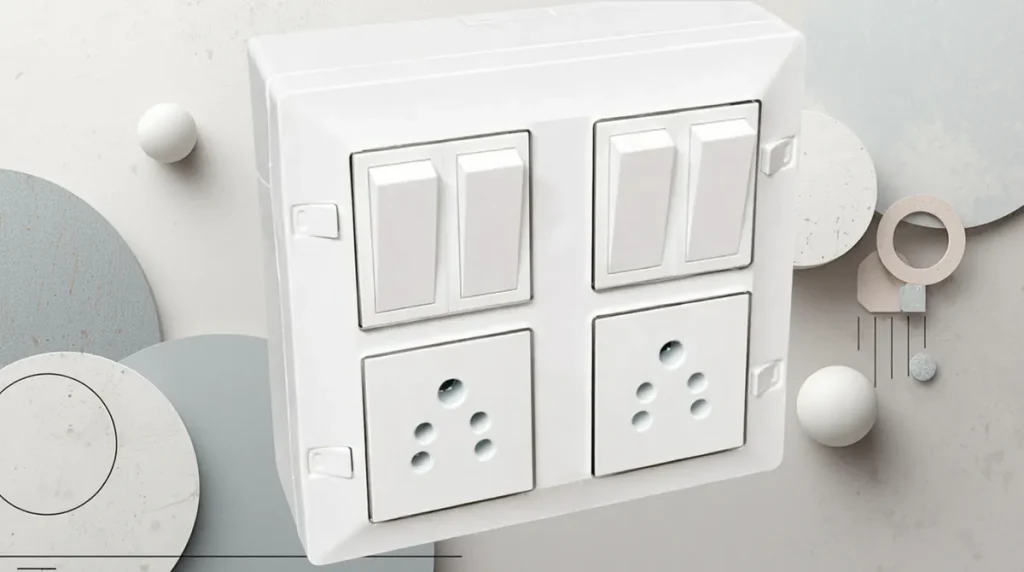
An 8 module switch board is the plate you end up buying for almost every bedroom, drawing room and shop counter in Hyderabad, and it is also the one people get wrong most often. The plate looks simple. Eight small squares, a frame, a few screws. But the module count decides the wall box, the depth of the cut in the wall, how crowded the wiring gets behind it and whether the electrician can close it neatly on the day. Pick the wrong count and you find out when the plate will not sit flush, or when the fan regulator will not fit next to a 16A socket.
This guide is about sizing and planning, not about which brand has the nicest finish. If you want the brand side, we have already written it up in our Legrand modular switches buying guide and the Anchor by Panasonic switches guide. Here we stay on the practical question: how many modules does each board really need, what box goes behind it, and how do you plan a house or a small shop so you buy the right plates the first time.
What an 8 module switch board actually holds
A module is a unit of width on the plate. One switch takes one module. A 6A socket takes two. A 16A socket takes two as well in most Indian ranges, and a fan regulator usually takes two. So when someone says “8 module board”, they mean a plate with eight units of width, which could hold eight switches, or four switches and two sockets, or any mix that adds up to eight.
The word “board” is used loosely. In a shop you will hear plate, board, set and frame used for the same thing. The plate is the cover. The frame (sometimes called the mounting frame or grid) is the part that holds the modules and screws into the box. The box is what sits in the wall. Most mistakes happen because buyers treat these as one item. They are three, and they have to match.
A small warning on names. Some stores and listings write “8 model board” or “8 modular plate”. They mean the same thing. If you search with those spellings you will land on the same products. Always ask the counter for the module count and the series name, because an 8 module plate in one series is not interchangeable with another series.
The standard plate sizes and what each one holds
Indian modular ranges are built around a handful of plate sizes. The exact outer dimensions change between series, so treat the table below as a planning guide for how many units fit, and confirm the box size against the data sheet or carton of the series you choose.
| Plate size | Typical use | Example fill |
|---|---|---|
| 1 module | Single point, such as a doorbell switch | 1 switch |
| 2 module | Small utility spot, geyser or AC point | 1 switch plus 1 indicator, or 1 socket |
| 3 module | Light-use spots, passage, bathroom | 2 switches plus 1 socket space |
| 4 module | Small bedside or kitchen counter | 2 switches and 1 socket |
| 6 module | Standard bedroom entry or study wall | 3 switches, 1 socket |
| 8 module | Main bedroom, living room, shop counter | 4 switches, 1 socket, 1 regulator |
| 12 module | Drawing room main wall, office desk wall | 6 switches, 2 sockets, 1 regulator |
| 18 module | Large room, kitchen or home theatre wall, reception | 8 switches, 3 sockets, 1 regulator, 1 data point |
Those example fills are not rules. They show how eight, twelve or eighteen units get used up quickly once you count sockets and regulators as double width. The most common surprise is exactly that. A buyer counts “six things I want” and buys a 6 module plate, then finds that two of those things are sockets and the plate is already full at four items.
How to count modules properly, step by step
Do this on paper before you visit any shop. It takes ten minutes per room and saves a lot of argument later.
Stand at the entrance of the room and list everything that will be switched or plugged in from that wall. Lights first, then fans, then the AC or geyser, then sockets for the TV, charger, laptop, mixer or whatever sits near that wall. Write each as a number of modules. A switch is one. A 6A or 16A socket is two. A fan regulator is two. An AC or geyser switch, which is usually a 20A double-pole type, is often two as well. A USB charging socket or a data point is typically one or two depending on the range. An indicator or a blank is one.
Add them up. Then add a spare of at least one module, because every house ends up wanting one more charging point. If the total is seven, buy an 8 module plate and you have your spare. If the total is eight, jump to the next size or split the load across two plates. A plate filled to the last unit leaves no room for a blank, and a blank is what covers a switch position you decide not to use.
Two things to check before you commit. First, whether any of your items are wider than normal. Some ranges have a wide switch for a bell push or a speaker control. Second, whether you want a “two way” function on any switch. Two-way switching, where a light is switched from the door and from the bedside, uses a different switch part but not extra width. It does need an extra wire back to the other point, so tell your electrician early.
The wall box is the real constraint
The plate hides the box, and the box decides everything. Concealed wiring uses a metal or PVC box set into the wall before plastering. Surface wiring uses a box that stands out from the wall. Either way, the box must match the plate size, and the plate must match the series, because the screw holes and the grid spacing differ.
A few practical rules from the site side.
Box size follows module count. Small plates fit the small square or short rectangle boxes. As the count goes up the box gets wider, and large plates such as 12 and 18 module need a bigger rectangular box. We are not giving millimetre numbers here on purpose. They vary between series, and the number on the box carton or the series data sheet is the one that counts.
Depth matters as much as width. A fan regulator and a 16A socket sit deeper than a plain switch, and the cables bend behind them. A shallow box makes the electrician force the cables, and that loosens terminals over time. Ask for a box depth that suits the heaviest item on that plate, not the lightest.
Metal box or PVC box is a site decision. Metal gives a solid earth bond if you connect it, and it handles heat from a loaded circuit well. PVC is lighter, cheaper and does not rust in damp walls, which matters in bathrooms and in older Hyderabad buildings that get seepage. Either is fine if it is fitted properly. What is not fine is a box set crooked, a box set too deep so the plate floats, or a box set too shallow so the plate will not close.
Always buy the plates and boxes together, or at least from the same series, and test one set on a spare box before ordering the whole house. That test takes a minute and avoids a week of delays on site.
Room-by-room board plan for a typical 2 or 3 BHK
This is a plan you can adapt, not a rule. Every home has its own habits.
Main bedroom. This is the natural place for an 8 module board at the entry or by the bed. A good fill is three light switches, one fan regulator, one 6A socket for a lamp or charger, and a spare. Keep a separate small plate near the bed for chargers, so the entry board stays neat. Add a dedicated 16A socket and a 20A switch for the AC on its own plate, higher on the wall near the unit.
Living room. Here an 8 or 12 module board earns its place. Lights are the main load, so you often need four or five switches. Add the fan regulator, a socket for a floor lamp or a vacuum cleaner, and a spare. The TV wall wants its own group: a couple of 6A sockets, a 16A socket if you have a big sound system, and a data or TV point. Many people forget this group at the planning stage and end up with extension boards, which is exactly what a good plan avoids.
Kitchen. The kitchen works best on a 12 or 18 module arrangement, or on two 8 module plates placed at the counter. A typical counter needs a 16A socket for the microwave, one for the mixer or grinder, one for the toaster or kettle, one for the water purifier, and a fridge point at a safe height away from the sink. Add a switch for the chimney and one for the light. Heavy appliances should not share one socket through a multiplug. Give each a socket on its own circuit where you can.
Bathrooms. A 3 or 4 module plate is enough. One light, one exhaust fan, and a 16A or 20A switch for the geyser with an indicator. Keep sockets away from splash zones and use plates rated for the damp, with a proper box.
Study or home office. A 6 or 8 module board with two or three 6A sockets, one 16A socket, a fan regulator and a data point. Plan for more charging points than you think. A desk with a laptop, a monitor, a phone charger, a lamp and a router is already five sockets.
Passage and balcony. Small plates. A 2 or 3 module plate for lights and a bell push. A balcony point should be covered and rated for outdoor use.
Planning a shop counter or small office
A shop in Hyderabad usually has a very different load pattern from a home. A counter has a billing machine, a printer, a UPS, a card machine, a charging point and maybe a small fridge or fan. Put these on a 12 or 18 module board mounted at a convenient height, not on the floor near the skirting where they get kicked and wet.
Give the UPS and the computers their own sockets, not shared with the fridge or the compressor. A fridge starts hard, and its starting surge is the kind of thing that makes a computer reboot if both sit on the same weak circuit. If your office has a UPS, our modular switches and accessories range includes the sockets you need to keep sensitive loads separate, and it helps to match them with a proper protection scheme upstream.
For offices with a lot of desks, the answer is usually a desk-level trunking or floor box with several sockets, rather than a long chain of wall plates. Wall plates are for the wall. A shop with a dozen counters does not want a dozen plates at random heights.
Switch and socket ratings you must not mix up
Module count is only half of the choice. The other half is the rating of each piece, and here a mistake is not a style error, it is a safety one.
A 6A switch controls lights and fans. A 6A socket suits chargers, lamps, a small TV and similar light loads. A 16A socket is for heavier appliances like a microwave, a washing machine, an iron or a geyser. Do not plug a 16A load into a 6A socket, and do not wire a 16A socket on thin cable. In India the plugs and sockets are covered by IS 1293 and the domestic switches by IS 3854. These are the standards a reputable range should state compliance with. Ask for the marking on the product, and be careful of a cheap unbranded part that carries a look-alike but not the marking.
Air conditioners and geysers should be switched through a double-pole switch rated for the load, typically 20A, and wired with a cable sized for it. A 6A switch on an AC circuit may work for a week and then run hot. If the switch face feels warm after the AC has been on for an hour, stop and have it checked.
Fan regulators are the other common mistake. Choose an electronic regulator suited to the type of fan, and keep a spare module around it, because regulators generate a little heat and a neighbour switch will feel it in a closed box. Spacing a regulator two units away from a heavy socket is a small thing that adds years to the plate.
Heights and spacing that electricians use on site
There is no single legal height for every switch, but there are common practices that make a house comfortable. Switch boards are usually fixed at around 1.2 to 1.4 metres from the floor so an adult and a child can both reach them. Sockets for general use sit lower, around 300 to 400 mm above the floor. Kitchen counter sockets go above the counter, kept clear of the sink and the hob. AC points go high near the unit. Chargers near a bed go at bedside height, not at floor level.
Keep boards at the same height across a room, and align them with the door frame. Nothing makes a finished room look cheaper than switch plates at five different levels. If you are working with a designer or a contractor, give them a simple sketch of the wall with the board height marked. A five minute sketch beats an argument in front of a plastered wall. The wiring itself should follow the accepted practice in IS 732, and an electrician who has worked on concealed wiring will know the colour coding and the loop rules.
Mistakes we see most often with 8 module boards
Buying the plate before the box. The plate is cheap, the box is hidden. When the box arrives, the screw spacing does not match the series. Buy both together.
Filling every unit. A plate with no spare and no blank leaves no room to adapt. Keep one module for a blank or for the point you will want in two years.
Using a long strip of small plates instead of one larger plate. A row of three 3 module plates costs more labour and looks untidy. One 8 or 12 module plate is cleaner and easier to wire.
Forgetting that sockets take two. This is the biggest one. Count in modules, not in items.
Mixing series on the same wall. Two ranges that look alike in the shop look different on the wall. Colour, gloss and edge thickness vary, and the gap between plates becomes obvious. Keep one series per house, or at least per floor.
Loading too many appliances on one board. An 8 module board with three heavy sockets is not a problem. The same board with six heavy sockets on one circuit is. Count the amperes behind the board, not just the units on the front. A neat plate cannot fix an overloaded circuit.
Skipping the earth. A three-pin socket without a connected earth is a decoration. Make sure the earth pin is wired to a real earth, and test it. We cover the earthing side in our earthing and lightning protection guide.
Choosing a series for your plan
Once you know the module counts, picking a series is simpler. If you like a clean, slim look, look at ranges with a flat plate and concealed screws. If you want a more traditional look, there are ranges with rocker switches and visible frames. Brand and range comparison is covered in the two guides linked above. A few things are worth checking whatever series you choose.
Look at the plate sizes the series offers. Some ranges go from 1 to 18 module, others stop at 12. If you plan a big kitchen wall or a TV wall, make sure the series has the larger plate.
Check what accessories are in the range, such as USB sockets, data points, indicators, dimmers and blanks. Not every range has all of them in the same finish. If you plan to use any of these, confirm availability before you commit to a series for the whole house.
Look at the finish in person. A white plate under a showroom light is not the same as a white plate on a painted wall in your house. If you can, ask to see two or three on a sample wall.
Ask about the warranty and the spares. A modular range lasts longer if replacement modules remain available. We stock a number of series, including Anchor by Panasonic and other ranges on our modular switches page, and can pull the data sheets for the one you are considering.
Buying in Hyderabad: quantities, ordering and checking
Work out a bill of quantities room by room before you order. For each room, write the plate size, the series and the number of plates, then the modules that go into each plate. Add boxes and any covers or blanks. Do the same for the whole house and give the electrician one consolidated list.
Order a few extra plates and modules, say five to ten percent, because breakage happens during fitting. Keep the box of spares. Matching a colour or a finish a year later is difficult if the batch has changed.
When the order arrives, open a few cartons and check them. Look at the markings, the screw terminals, the plate edges and whether the module clicks into the frame. A loose click is a sign of a poor mould. Do the count at delivery, not after the first week.
If you are buying for a project such as a block of flats or a commercial space, ask for a series quote with module-wise rates and the price list. We keep a set of current price lists on our price lists page, and our team in Rasoolpura can help you turn a floor plan into a quantity sheet.
A quick checklist before you place the order
- Counted modules per wall, with sockets and regulators as two units each.
- At least one spare unit or blank on each plate.
- Box size and depth confirmed for the series, and for the heaviest item.
- Correct ratings: 6A for lights, 16A for appliances, 20A double-pole for AC and geyser.
- Earth wired and tested on every three-pin socket.
- One series throughout the house or floor.
- Five to ten percent extra modules and plates for breakage.
Frequently asked questions
How many switches fit in an 8 module switch board?
Eight single-width switches fit if you use only switches. In practice a board mixes types. A common fill is four switches, one 6A socket and one fan regulator. Sockets and regulators take two modules each, so count in module units, not in items.
What size box does an 8 module plate need?
It needs a box made for 8 module plates in the same series. The width and screw spacing differ between brands and ranges, so confirm the size against the series data sheet or the carton. Buy the box with the plate and test one before ordering the full quantity.
How many modules do I need for a bedroom?
Most bedrooms need one 8 module board at the entry for lights, a fan regulator and a socket, plus a smaller plate at the bedside for chargers, and a separate AC point. Add a spare unit so you can add something later without changing the plate.
Is a 6A socket the same as a 16A socket?
No. A 6A socket suits light loads such as chargers and lamps. A 16A socket is for heavy appliances such as a microwave or geyser, and needs a thicker cable and a proper circuit. The plug pins and socket openings are different on purpose, so you cannot swap one for the other safely.
Can I use a 3 module board for a kitchen?
Not for a working counter. A kitchen needs several 16A sockets and a few switches, which fill a 12 or 18 module plate, or two 8 module plates. A 3 module plate fits a bathroom or passage better.
Do all brands use the same 8 module plate size?
No. The module count is the same idea, but the outer size, frame and box fit differ between series. Do not mix a plate from one series with a frame or box from another.
Where can I buy modular switch boards in Hyderabad?
You can buy them at an electrical distributor with a range of series on the counter. At eNarayan Elex in Rasoolpura we stock several modular ranges and can help you plan module counts before you order.
If you have a floor plan, send it to us with the list of appliances for each room and we will help you turn it into a module-wise quantity sheet. Start from our modular switches and accessories page, or visit our counter in Rasoolpura, Hyderabad.
